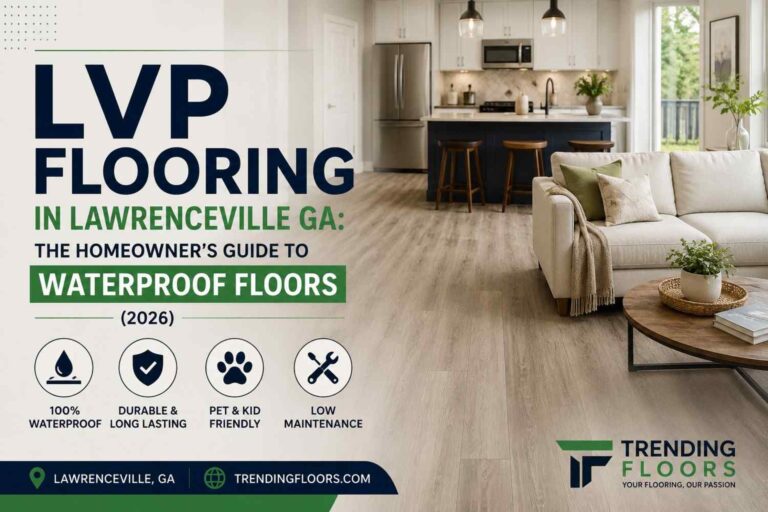
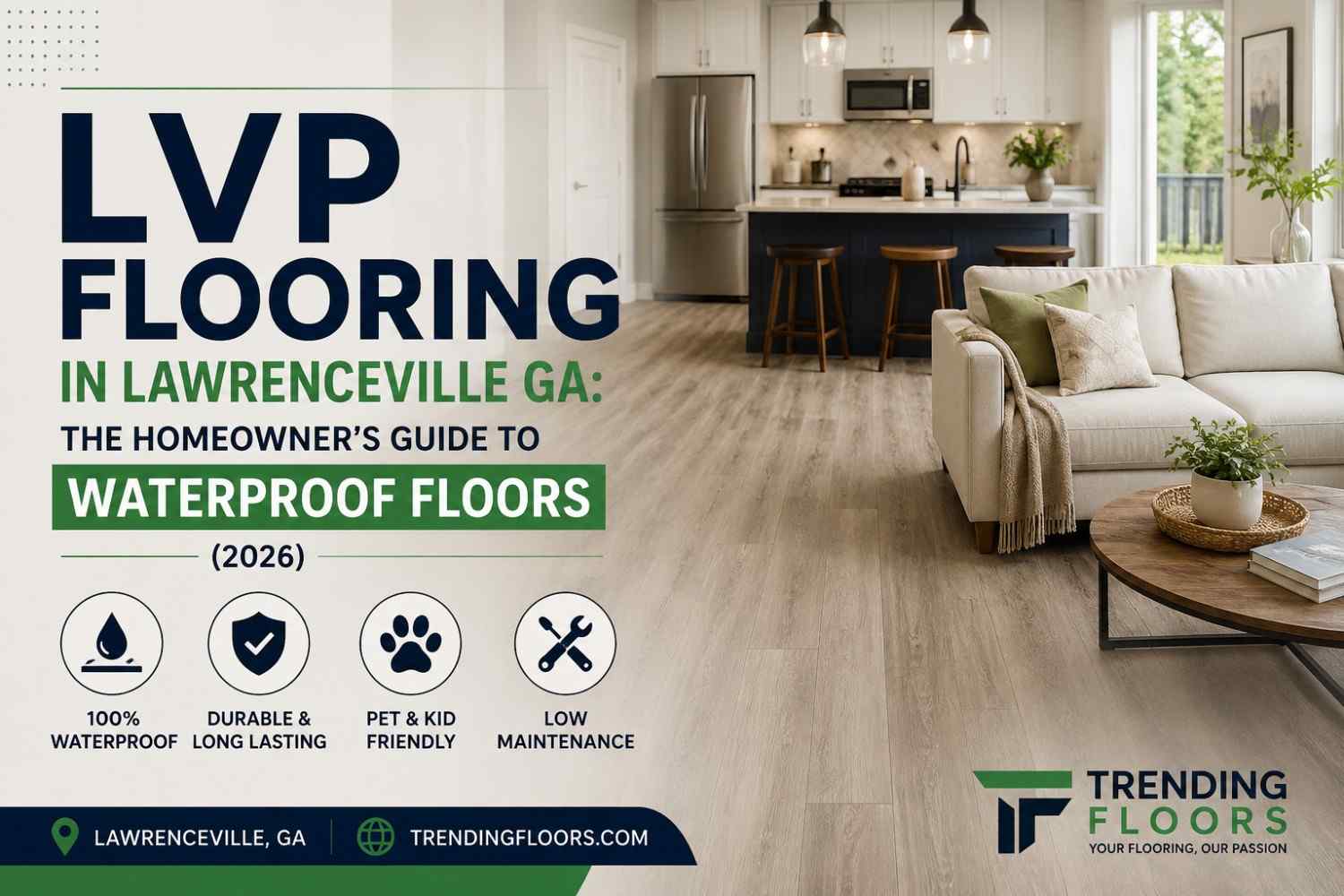
Luxury vinyl plank flooring has become the most popular flooring choice in Lawrenceville — and across Gwinnett County — for reasons that go well beyond price. LVP is 100% waterproof through the core, handles Georgia’s humidity and concrete slab foundations better than any wood product, installs in a fraction of the time hardwood requires, and now comes in formats that are genuinely difficult to distinguish from real wood at normal viewing distance. For Lawrenceville’s active family households, this combination of performance and aesthetics is nearly impossible to argue against.
But not all LVP is the same product. The difference between a $1.50 per square foot LVP and a $4.50 per square foot LVP is not just marketing — it is wear layer thickness, core construction, dimensional stability, and long-term performance under Gwinnett County’s specific conditions. This guide gives Lawrenceville homeowners the complete picture: what LVP actually is, how to choose the right specification for each room and household type, what professional installation involves, and what it realistically costs in 2026.
Why LVP Is the Right Choice for Most Lawrenceville Homes
Gwinnett County’s Slab Foundation Reality
The overwhelming majority of Lawrenceville homes — and the broader Gwinnett County housing market — sit on concrete slab foundations. This single construction fact shapes every flooring decision for most local homeowners. Concrete slabs emit moisture vapor continuously, even when they feel completely dry on the surface. This vapor is what causes solid hardwood installed over concrete to cup, gap, and eventually buckle — a failure mode that flooring contractors see regularly in Gwinnett County homes where the moisture testing step was skipped.
LVP is completely immune to this problem. Its waterproof core — whether SPC (stone-plastic composite) or WPC (wood-plastic composite) — does not absorb moisture vapor, does not expand or contract in response to humidity changes, and performs identically over a Gwinnett County concrete slab as it does over a wood subfloor. This is the foundational reason LVP dominates the Lawrenceville market.
Georgia’s Humidity Profile
Lawrenceville’s climate mirrors Metro Atlanta’s humid subtropical conditions — average annual relative humidity of approximately 69%, with summer peaks regularly reaching 75–80% during the June through September rainy season. These humidity swings cause solid hardwood to move measurably through the year. Even engineered hardwood, while significantly more stable than solid wood, responds to extreme humidity differentials over time.
LVP is genuinely indifferent to these conditions. It neither absorbs nor releases moisture, maintaining identical dimensional stability in January’s drier air and August’s peak humidity. For Lawrenceville homeowners who want a wood-look floor without the climate management requirements that real wood demands, LVP’s humidity indifference is a genuine practical advantage — not a marketing claim.
Red Georgia Clay and Active Family Life
Lawrenceville’s yards produce the red Georgia clay that every Gwinnett County homeowner knows — and LVP handles it better than any other flooring material. A matte-finish LVP floor sweeps and mops clean quickly after clay tracks in from the yard. It does not stain, does not require special cleaning products, and does not show wear from the abrasive fine-clay particles that gradually dull softer flooring surfaces. For Lawrenceville families with dogs, children, and active outdoor lifestyles, this practical maintenance advantage compounds significantly over a 10-to-15-year floor life.
LVP Core Types — The Most Important Technical Decision
The core construction of an LVP plank determines its dimensional stability, sound profile underfoot, resistance to denting, and how it handles temperature fluctuations in Lawrenceville’s climate. There are two main core types and one premium hybrid option.
SPC — Stone-Plastic Composite
SPC core LVP is constructed from a blend of limestone powder and PVC — a combination that produces an extremely dense, rigid plank. SPC is the most dimensionally stable LVP core type available, making it the correct choice for Lawrenceville homes with temperature variations (garages with adjacent rooms, sunrooms, rooms with radiant heating) or for households where heavy furniture, rolling chairs, or high-impact activities are regular factors.
SPC core LVP is also thinner and denser than WPC, which makes it slightly less comfortable underfoot without underlayment but better at resisting denting from concentrated loads. The density that makes it rigid also makes it quieter when installed with appropriate underlayment — it transmits less impact noise than less dense alternatives.
SPC is the core type we recommend for main living areas, kitchens, mudrooms, and any room in a Lawrenceville home where temperature stability and heavy use are the primary considerations.
WPC — Wood-Plastic Composite
WPC core LVP uses a foamed polymer core rather than a stone-based composite. This produces a plank that is warmer and softer underfoot than SPC — closer to the feel of real hardwood — but slightly less dimensionally stable in extreme temperature fluctuations and less resistant to heavy concentrated loads.
WPC is a strong choice for Lawrenceville bedrooms, home offices, and living areas where comfort underfoot and warmth are priorities and temperature swings are moderate. Its built-in underlayment cushion reduces the need for separate underlayment in many installations and provides better sound absorption than SPC without additional padding.
Hybrid Rigid Core — The Premium Option
Hybrid rigid core flooring combines the dimensional stability of SPC with an enhanced comfort layer that approaches WPC’s underfoot feel — producing a product that outperforms standard LVP on virtually every metric. It is quieter, warmer, more dent-resistant, and more dimensionally stable than either standard core type.
For Lawrenceville homeowners who want the best-performing LVP available — particularly for open-plan main floors in active households or for homes where the flooring investment is expected to last 20+ years — Trending Floors carries and installs hybrid rigid core flooring as a premium alternative to standard LVP. The cost premium over standard SPC is typically $1–$2 per square foot — an investment that returns in performance over the floor’s lifetime.
Wear Layer Thickness — The Number That Determines Durability
The wear layer is the clear protective coating on top of the LVP plank — the layer that everything actually contacts during daily use. Its thickness, measured in mils (thousandths of an inch), is the single most important specification number for predicting how long an LVP floor will look good under Lawrenceville’s household conditions.
Understanding the Mil Scale
- 6–8 mil: Builder-grade and entry-level retail product. Appropriate only for very low-traffic spaces. Begins showing wear within 3–5 years in normal household use. Not recommended for any main-floor application in an active Lawrenceville household.
- 12 mil: Standard residential grade. Adequate for bedrooms and low-traffic areas. Holds up for 7–10 years with normal household use.
- 20 mil: The minimum specification for main-floor applications in active Lawrenceville households. Handles pet claws, children’s activity, furniture movement, and daily cleaning without visible wear for 15+ years with proper maintenance.
- 28 mil+: Commercial-grade specification. Used in high-traffic residential applications — open-plan main floors in very active households, homes with multiple large dogs, or households where the floor is expected to perform without concern for 20+ years.
The budget LVP products available at big-box stores are almost exclusively 6–12 mil products. The price difference between a 6-mil product and a 20-mil product is $1–$2 per square foot in materials. Over a 1,500 square foot main floor, that difference is $1,500–$3,000 — and the 20-mil floor will still look new when the 6-mil product needs replacement.
Trending Floors carries a full range of LVP flooring options in Atlanta — including 20-mil residential and 28-mil commercial-grade products — with honest guidance on which specification makes sense for each Lawrenceville household’s specific use patterns.
Choosing LVP by Room — Lawrenceville-Specific Guidance
Main Living Areas and Open-Plan Floors
Wide-plank SPC core LVP with a 20-mil wear layer in a warm oak format is the correct specification for Lawrenceville main floors. The 7″–9″ plank widths that now dominate the market suit the open floor plans common in Gwinnett County’s 1990s–2010s housing stock and create the continuous visual flow that makes main floors feel cohesive rather than segmented. Matte finishes in warm oak tones — natural honey oak, white oak, and warm greige — are the dominant trend in Lawrenceville in 2026, replacing the cool gray formats that saturated the market for the previous decade.
Kitchens
Kitchens are one of LVP’s strongest applications in any Lawrenceville home. The 100% waterproof core handles spills, pet water bowls, and the general moisture environment of a working kitchen without any risk of long-term damage. The smooth surface cleans quickly — no grout lines to scrub, no surface texture to trap cooking residue. A 20-mil SPC core LVP in the same format as the adjacent living area creates a seamless visual flow that makes open-plan Lawrenceville homes feel larger and more cohesive.
Bathrooms
LVP is appropriate in bathrooms as long as the installation is executed correctly — specifically, expansion gaps at walls must be properly sealed, and transition strips at shower surrounds must be watertight. A properly installed 20-mil LVP in a bathroom handles normal residential moisture exposure without any problem. For master bathrooms with steam showers or significant standing water exposure, large-format tile remains the more conservative choice.
Basements
For Lawrenceville homes with finished basements or basement bonus rooms — increasingly common in the newer construction of western Gwinnett County — LVP is the only wood-look flooring that is appropriate without reservation. Basements have the most direct concrete slab moisture vapor exposure of any room in the home. LVP’s waterproof core handles this without any additional moisture mitigation in most cases, though a moisture test before installation remains the professional standard even in basement applications.
Bedrooms
LVP works in bedrooms — but this is where WPC core or hybrid rigid core products earn their premium. The warmer, softer underfoot feel of these cores is more noticeable in bedrooms where bare feet are the norm. A 12-mil WPC core product is entirely adequate for a Lawrenceville bedroom with light traffic. Households who want consistent flooring specification throughout the home — same format, same core, same wear layer everywhere — should specify 20-mil SPC throughout rather than varying products by room.
What LVP Installation Actually Involves in Lawrenceville
Understanding the professional installation process helps Lawrenceville homeowners evaluate any contractor they’re considering — and identify the shortcuts that separate budget installations from professional ones.
Subfloor Assessment and Moisture Testing
The first step in any professional LVP installation is subfloor assessment. The concrete slab must be checked for level (LVP manufacturers typically require the subfloor to be within 3/16 inch over 10 feet — high spots must be ground down, low spots filled with self-leveling compound), structural integrity, and moisture vapor emission rate. Even for LVP — which is waterproof — excessive moisture vapor can affect adhesive performance in glue-down installations and can create conditions for mold growth between the slab and the flooring if not addressed.
Acclimation
Quality LVP products require 24–48 hours of acclimation in the installation environment before installation begins. This allows the planks to reach the temperature equilibrium of the room, preventing minor dimensional changes during and after installation. Contractors who skip acclimation are taking a shortcut that can result in gapping or buckling after installation, particularly in Lawrenceville homes with significant HVAC temperature differentials between summer and winter.
Floating vs. Glue-Down Installation
Most residential LVP in Lawrenceville is installed as a floating floor — planks click-lock together and float above the subfloor without adhesive. This method is faster, allows easier future repairs (individual planks can be replaced without affecting adjacent flooring), and is appropriate for most residential applications. Glue-down installation bonds planks directly to the concrete and produces a more solid underfoot feel with less noise — it is preferred in larger open-plan spaces and in any installation where the floating floor feel is objectionable.
Expansion Gaps and Transitions
LVP requires expansion gaps at all walls, door frames, and fixed objects — typically 1/4 inch — to allow for the minor dimensional movement that occurs with temperature changes. These gaps are covered by baseboards and transition strips. A contractor who skips proper expansion gaps will produce a floor that buckles as indoor temperatures rise in Lawrenceville’s summer months. Trending Floors’ flooring installation services in Atlanta include professional expansion gap management and transition installation on every project.
What LVP Flooring Costs in Lawrenceville GA (2026)
Lawrenceville LVP costs vary by core type, wear layer specification, plank format, and installation method. Here are realistic all-in (materials plus labor) ranges for 2026 Gwinnett County projects:
- Entry-level LVP (12-mil, WPC core) installed: $3–$5 per square foot
- Mid-grade LVP (20-mil, SPC core) installed: $5–$8 per square foot
- Premium LVP (28-mil, SPC core) installed: $7–$10 per square foot
- Hybrid rigid core installed: $8–$12 per square foot
- Old floor removal and disposal: $0.75–$1.50 per square foot additional
- Subfloor leveling: $2–$5 per square foot additional if needed
- Stair installation (LVP treads and risers): $35–$65 per stair additional
A full main-floor LVP installation in a typical Lawrenceville home (1,200–1,800 square feet) runs between $6,000 and $14,000 depending on product specification and subfloor condition. Larger Gwinnett County homes covering 2,000+ square feet typically run $10,000–$20,000 for a full main-floor project with mid-to-premium LVP.
Trending Floors offers flooring financing options in Atlanta that make it practical to do the full main floor in one project rather than room by room — which is almost always the more cost-effective approach when contractor mobilization and subfloor preparation are factored in.
LVP vs. Other Flooring Options for Lawrenceville Homes
LVP is the right choice for most Lawrenceville households — but it is worth understanding where other materials are genuinely better.
- LVP vs. Engineered Hardwood: Engineered hardwood delivers authentic real wood character and higher resale value in homes where the premium matters. LVP wins on waterproofing, lower maintenance requirements, lower cost, and complete immunity to Gwinnett County’s slab moisture conditions. For households prioritizing practicality over resale optics, LVP is the correct choice. For households planning to sell within 3–5 years in a competitive price bracket, engineered hardwood may return more at the transaction.
- LVP vs. Tile: Tile is harder, colder underfoot, and requires grout maintenance. LVP is warmer, more comfortable, and easier to maintain. Tile remains the better choice for bathrooms, mudrooms, and wet zones where standing water and heavy cleaning cycles are the norm. LVP is better for living areas and bedrooms where comfort and warmth matter.
- LVP vs. Carpet: Carpet provides warmth and sound absorption that LVP cannot match in bedrooms and bonus rooms. LVP is the better choice for every other room in a Lawrenceville home — main floor, kitchen, dining room, and playroom.
- LVP vs. Laminate: Laminate is not waterproof — it swells and delaminates when exposed to moisture. In Lawrenceville’s slab homes and Georgia’s humid climate, LVP is significantly safer than laminate in virtually every application. The price difference between quality LVP and quality laminate is small enough that laminate rarely makes sense in this market.
Frequently Asked Questions — LVP Flooring in Lawrenceville GA
For additional questions about flooring materials, installation timelines, and costs, visit our Atlanta flooring FAQ — covering the most common questions from Lawrenceville and Gwinnett County homeowners.
What is the best LVP flooring for Lawrenceville GA homes?
For most Lawrenceville main-floor applications, SPC core LVP with a 20-mil wear layer in a wide-plank (7″–9″) warm oak format is the correct specification. The SPC core handles Georgia’s humidity and Gwinnett County’s concrete slab conditions with full dimensional stability. The 20-mil wear layer provides the surface durability needed for active family households over a 15+ year floor life. For households wanting the premium option, hybrid rigid core LVP combines SPC-level stability with enhanced underfoot comfort and noise reduction.
How long does LVP flooring last in Lawrenceville GA?
Quality LVP with a 20-mil or thicker wear layer, professionally installed over a properly prepared subfloor, lasts 15–25 years in normal Lawrenceville residential use. Builder-grade LVP with 6–8 mil wear layers may show visible wear within 5 years in main-floor applications. Georgia’s humidity has no effect on LVP lifespan — the waterproof core is genuinely indifferent to moisture conditions that would damage wood flooring over the same period.
Is LVP better than hardwood for Lawrenceville GA slab homes?
For Lawrenceville’s concrete slab homes, LVP is safer and more practical than solid hardwood. Solid hardwood should not be installed directly over concrete slabs — the moisture vapor concrete emits continuously will damage solid wood over time regardless of how dry the surface feels. LVP eliminates this risk entirely. Engineered hardwood is an appropriate wood alternative for slab homes with proper moisture testing and preparation, but at higher cost and with greater maintenance requirements than LVP.
What wear layer thickness should I choose for LVP in Lawrenceville?
For main living areas and kitchens in active Lawrenceville households — particularly homes with children, pets, or high daily traffic — 20-mil is the minimum specification worth considering. For bedrooms and lower-traffic rooms, 12-mil is adequate. For Lawrenceville families with multiple large dogs or very high traffic main floors, 28-mil commercial-grade LVP is worth the additional cost. Never choose a product below 12-mil for any residential application in an active household.
How much does LVP installation cost in Lawrenceville GA in 2026?
LVP installation in Lawrenceville runs $3–$5 per square foot for entry-level 12-mil products, $5–$8 for mid-grade 20-mil SPC, and $7–$12 for premium and hybrid rigid core products — all installed. A full main-floor project in a typical Lawrenceville home (1,200–1,800 sq ft) runs $6,000–$14,000. Subfloor leveling and old floor removal are additional costs that vary by project. A free in-home estimate gives the most accurate number for your specific home.
Can LVP be installed over existing flooring in Lawrenceville?
In some cases, yes — floating LVP can be installed over existing smooth, level, well-bonded flooring (existing LVP, sheet vinyl, or well-adhered tile) without full removal. However, this adds height at transitions and may create issues at doorways and adjacent rooms. Old flooring that is uneven, damaged, or loose must be removed first. A professional subfloor assessment is required before any decision about installing over existing floors — skipping this step is one of the most common installation shortcuts that leads to premature floor failure.
What is the difference between SPC and WPC LVP for Lawrenceville homes?
SPC (stone-plastic composite) core LVP is denser, more rigid, and more dimensionally stable — the better choice for main living areas, kitchens, and rooms with temperature variation in Lawrenceville homes. WPC (wood-plastic composite) core LVP is warmer and softer underfoot — the more comfortable choice for bedrooms and lower-traffic areas where the enhanced underfoot feel is noticeable. Hybrid rigid core combines both advantages and is the premium option for homeowners who want the best-performing LVP available for a full-home installation.
Get a Free LVP Flooring Estimate in Lawrenceville GA
Trending Floors is a licensed, insured flooring contractor based right here in Lawrenceville — at 465 Maltbie Street, Suite 240. We install LVP, hybrid rigid core, engineered hardwood, tile, carpet, and epoxy flooring throughout Lawrenceville, Gwinnett County, and Metro Atlanta. We bring product samples to your home, assess your subfloor, and give you a written estimate covering every cost component clearly — no pressure, no surprises on installation day.
Book your free LVP flooring consultation in Lawrenceville today and get honest local advice from a contractor who actually lives and works in Gwinnett County.
About Trending Floors
Trending Floors is a licensed and insured flooring contractor based at 465 Maltbie Street, Suite 240, Lawrenceville, GA 30046, serving Lawrenceville, Gwinnett County, and Metro Atlanta homeowners since 2018. We install LVP, hybrid rigid core, engineered hardwood, hardwood, tile, carpet, and epoxy flooring — all with our own trained crews, written estimates, and workmanship warranties.
(404) 944-2548 | estimates@trendingfloors.com | Mon–Sat 8am–6pm