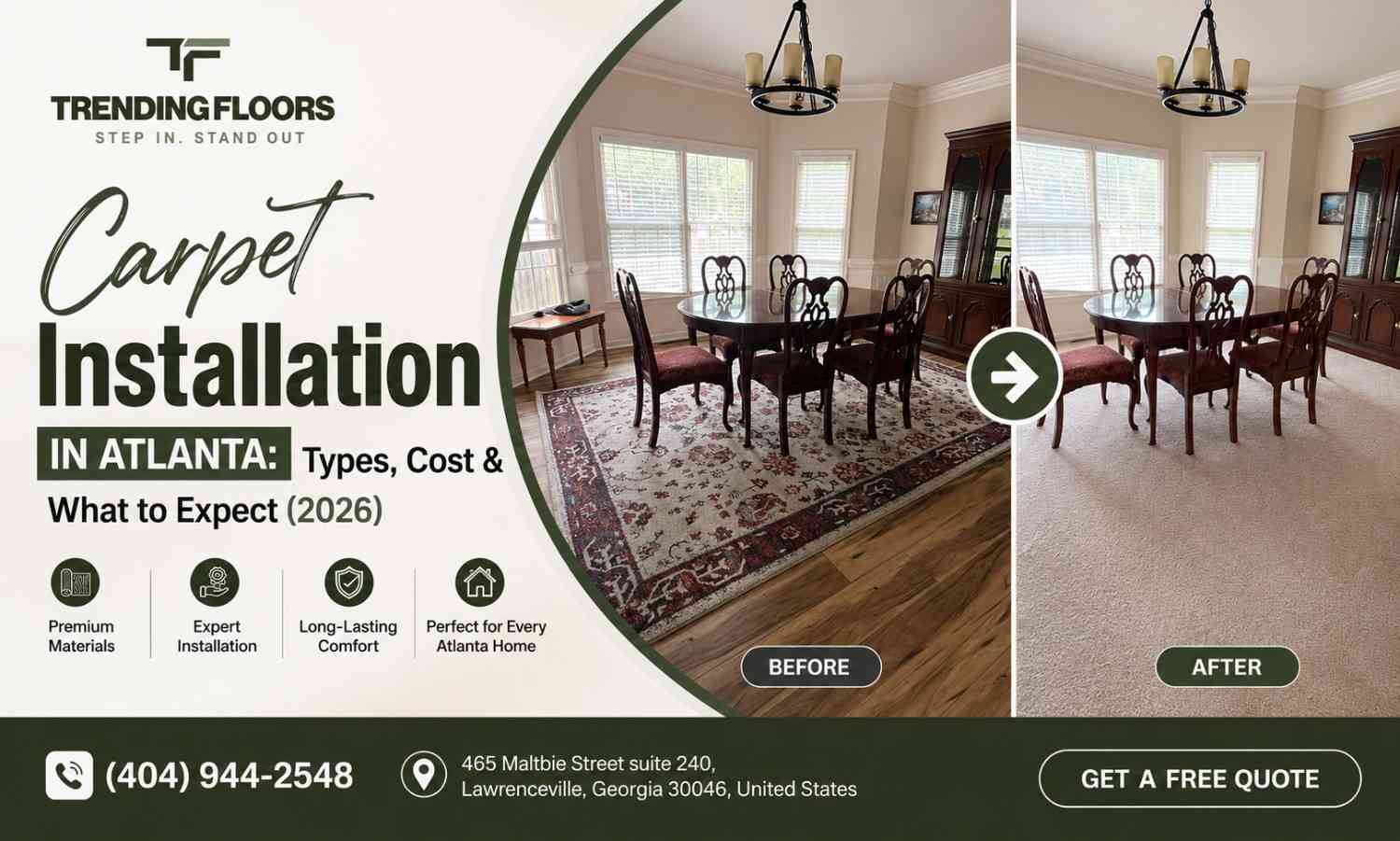
Carpet has a complicated reputation in Atlanta right now. On one hand, the city’s design trends have pushed hard toward LVP and engineered hardwood over the past decade. On the other, most Atlanta homeowners who renovate their main floors still end up carpeting at least some rooms — and for good reason. No hard surface replicates what carpet does in a bedroom, a bonus room, or a finished basement: warmth, quiet, and a comfort underfoot that makes a room feel genuinely livable.
The mistake most homeowners make isn’t choosing carpet. It’s choosing the wrong type of carpet for the room, the climate, and the household — or working with a contractor who doesn’t account for Georgia’s humidity before laying a single tack strip. This guide covers everything Atlanta homeowners need to make a smart carpet decision in 2026: fiber types, pile construction, padding, cost, and the installation process from start to finish.
Where Carpet Still Makes Sense in Atlanta Homes
Before getting into fiber types and cost, it’s worth being direct about where carpet belongs — and where it doesn’t — in a Metro Atlanta home in 2026.
Where Carpet Works Well
Bedrooms are carpet’s strongest application in any Atlanta home. The warmth underfoot on cool Georgia mornings, the sound absorption that keeps master suites quiet, and the soft landing for kids’ rooms make carpet genuinely the best choice here — better than any hard surface alternative for comfort and livability.
Bonus rooms, media rooms, home offices, and finished basements are also strong carpet applications, particularly where sound control matters. Carpet absorbs more sound than any other flooring material — a significant advantage in multi-story Atlanta homes where noise transfer between floors is a real concern.
Upstairs hallways and stair runners are another natural fit. Stairs with hard surface flooring are a slip hazard, particularly for children and older adults. Carpet on stairs provides traction and reduces the severity of falls — a practical safety consideration that matters in Atlanta’s active family households.
Where Carpet Doesn’t Work
Main living areas, kitchens, mudrooms, and anywhere that sees regular moisture, heavy traffic, or pet accidents are not appropriate for carpet in an Atlanta home. Georgia’s humidity combined with the red clay that tracks in from backyards creates maintenance challenges in carpeted main-floor areas that most homeowners underestimate at the time of purchase. The most common flooring regret we hear from Atlanta homeowners is wall-to-wall carpet in an open-plan main floor that proved impossible to keep clean.
The practical approach that most Metro Atlanta homeowners are taking in 2026: LVP or engineered hardwood throughout the main level, tile in wet zones, and carpet reserved for bedrooms, bonus rooms, and upper-floor areas. Each material in the right place, with no compromises anywhere.
Carpet Fiber Types — The Most Important Decision You’ll Make
Carpet fiber is the single most important variable in how a carpet performs over time. It determines durability, stain resistance, texture retention, and how well the carpet holds up in Atlanta’s humid climate. There are five main fiber types, each with a distinct performance profile.
Solution-Dyed Nylon — Best Overall Performance
Solution-dyed nylon is the highest-performing carpet fiber available for residential use, and it is the fiber we recommend most often to Atlanta homeowners who want their carpet to last. The “solution-dyed” designation means the color is added to the fiber during manufacturing — not applied to the surface afterward. This makes the color essentially permanent: it cannot be bleached out by sunlight, harsh cleaning products, or repeated professional cleaning.
Nylon is also the most resilient fiber in terms of texture retention — it springs back after compression better than any other option, which is why high-traffic areas in nylon carpet maintain their appearance far longer than comparable areas in polyester. In Atlanta households with kids, pets, and heavy daily use, solution-dyed nylon consistently outperforms every alternative over a 10-year horizon.
The trade-off is cost. Solution-dyed nylon is the most expensive fiber option — typically $4–$8 per square foot for materials alone before installation and padding.
Polyester (PET) — Best Value for Lower-Traffic Rooms
Polyester carpet — often marketed as PET, which stands for polyethylene terephthalate, the same material used in plastic bottles — has improved dramatically in quality over the past decade. Modern polyester carpets are inherently stain-resistant (the fiber doesn’t absorb liquid the way older synthetics did), soft underfoot, and available in a wide range of colors and styles.
The limitation of polyester is resilience. Under heavy traffic or compression from furniture, polyester fibers mat down and lose their texture faster than nylon. This makes it a practical choice for bedrooms and guest rooms with light foot traffic — but a poor choice for hallways, stairs, or any area that sees daily heavy use.
Recycled-fiber polyester carpets — made from post-consumer plastic bottles — are gaining popularity among Atlanta homeowners in 2026 who want more sustainable flooring options. They perform similarly to standard polyester and are available at competitive price points.
Polyester carpet typically costs $2–$5 per square foot for materials.
Triexta (PTT) — The Middle Ground
Triexta, sold under the brand name Smartstrand by Mohawk, is a newer fiber category that sits between nylon and polyester in both performance and price. It offers better stain resistance than nylon (the stain resistance is built into the fiber structure rather than applied as a surface treatment) and better resilience than polyester, particularly in low-to-moderate traffic areas.
Triexta is a strong option for Atlanta homeowners who want above-average stain resistance — particularly in households with young children — without paying full nylon pricing. It performs well in bedrooms and moderate-traffic living areas.
Wool — Premium Natural Fiber
Wool is the original carpet fiber and still the benchmark for luxury residential carpet. It is naturally soil-resistant, extremely durable, and has a depth and warmth that synthetic fibers cannot fully replicate. Wool also has natural moisture-wicking properties that can be an advantage in Georgia’s humid climate.
The limitations are significant: wool is expensive ($8–$20 per square foot for materials), requires professional cleaning, and is not inherently stain-resistant — spills that aren’t addressed immediately can set permanently. For most Atlanta homeowners, wool carpet makes sense only in formal rooms with controlled access and minimal daily traffic. It remains a popular choice in luxury homes in Buckhead, Ansley Park, and Druid Hills where the aesthetic premium justifies the cost and maintenance commitment.
Olefin (Polypropylene) — Outdoor and Basement Applications Only
Olefin is the most moisture-resistant carpet fiber — it does not absorb water, which makes it suitable for covered outdoor spaces, sunrooms, and basements with potential moisture exposure. However, it has very poor resilience and will mat down quickly under normal residential foot traffic. It is not a suitable choice for bedrooms, living areas, or stairs. Its applications are specific and limited.
Carpet Pile Types — Construction and Performance
Beyond fiber type, the way the carpet is constructed — its pile style — affects how it looks, how it wears, and how easy it is to maintain.
Cut Pile — The Standard for Atlanta Bedrooms
Cut pile carpet is made by cutting the yarn loops at the top, creating individual upright fibers. It is the most common residential carpet construction and the standard choice for Atlanta bedrooms and living areas. Within cut pile there are several sub-styles:
Saxony — Dense, smooth, formal appearance. Shows footprints and vacuum tracks easily. Best for formal rooms with low traffic.
Textured cut pile — Twisted yarns at different heights create a surface that hides footprints and everyday wear far better than Saxony. This is the most popular choice for Atlanta bedrooms and bonus rooms in 2026 — practical, attractive, and forgiving. Warm neutrals (greige, taupe, warm beige) in textured cut pile are the dominant trend across Metro Atlanta right now, replacing the cool grays of the past decade.
Frieze — Highly twisted, tightly curled fibers. Very casual appearance. Excellent at hiding footprints and wear. Popular in high-traffic areas and contemporary interiors.
Loop Pile — Durability for High-Traffic Zones
Loop pile carpet leaves the yarn loops intact rather than cutting them. The result is an extremely durable surface that resists crushing and matting — which is why loop pile (particularly Berber) is the standard choice for high-traffic hallways, stairs, and commercial applications. The trade-off is that loop pile can snag on pet claws, making it less suitable for households with cats or dogs that scratch.
Cut and Loop — Pattern and Texture Combination
Cut and loop combines both constructions to create geometric patterns and textural variation. It is gaining popularity in Atlanta bonus rooms and media rooms where homeowners want a more distinctive look without committing to a bold color.
Padding — The Component Most Homeowners Undervalue
Carpet padding is installed beneath the carpet and is one of the most important factors in how the carpet performs and feels underfoot — yet it’s also the component most homeowners pay the least attention to. According to the Carpet and Rug Institute, the right padding extends carpet life by up to 50% and significantly improves comfort, sound absorption, and thermal insulation.
For Atlanta homes, these are the key padding considerations:
- Density over thickness: A denser, thinner pad (6–8 lb density, 7/16″ thickness) supports the carpet better and lasts longer than a thicker, less dense pad that compresses quickly.
- Moisture resistance in Georgia: Atlanta’s humidity means moisture-resistant padding is worth the upgrade — particularly for bedrooms over slab foundations or any ground-floor carpet installation.
- Don’t skimp here: Budget padding under quality carpet is the single most common reason carpet wears out faster than expected. Upgrading padding is almost always money well spent.
What Carpet Installation Costs in Atlanta in 2026
Atlanta carpet installation costs vary based on fiber type, pile construction, padding grade, room complexity, and whether old carpet removal is included. Here are realistic 2026 ranges for Metro Atlanta projects:
- Basic polyester carpet installed with standard padding: $3–$5 per square foot all-in
- Mid-grade triexta or nylon installed with quality padding: $5–$8 per square foot all-in
- Premium solution-dyed nylon with upgraded padding: $8–$12 per square foot all-in
- Wool carpet installed: $12–$20+ per square foot all-in
- Old carpet removal and disposal: $0.50–$1.50 per square foot additional
- Stair carpet installation: $15–$30 per stair additional
A typical Atlanta bedroom (180–200 square feet) carpeted with mid-grade nylon and quality padding runs $900–$1,600 all-in. A full upper floor covering three bedrooms and a hallway (600–800 sq ft) typically runs $3,000–$6,400 depending on fiber selection. These are total project costs — materials, padding, labor, and old carpet removal included.
Trending Floors offers flexible financing options for carpet projects throughout Metro Atlanta, making it straightforward to carpet an entire upper floor in one visit rather than one room at a time.
Georgia Humidity and Carpet — What Every Atlanta Homeowner Needs to Know
Atlanta’s relative humidity regularly climbs above 70% during the summer months — and that has direct implications for carpet installation and performance that most national guides don’t address.
Subfloor Moisture Testing Is Not Optional
Before any carpet installation in an Atlanta home — particularly over concrete slab subfloors — moisture testing is a required step. Georgia’s slab-on-grade construction combined with summer humidity means subfloors can hold elevated moisture levels that will cause mold growth beneath carpet if not detected and addressed before installation.
A professional contractor should test subfloor moisture before laying tack strips. If moisture levels are elevated, a moisture barrier or remediation step is required before carpet goes down. Any contractor who proceeds without this check in an Atlanta home is taking a shortcut that creates a genuine mold risk.
Carpet Cleaning Frequency in Georgia’s Climate
The combination of Atlanta’s humidity, red Georgia clay, pollen (Atlanta consistently ranks among the highest pollen cities in the country), and outdoor foot traffic means carpet in Atlanta homes typically requires professional cleaning more frequently than national recommendations suggest. The practical schedule for most Atlanta households: professional cleaning every 12 months for low-traffic rooms, every 6–9 months for high-traffic areas, and prompt professional treatment for any significant spills or pet accidents.
The Carpet Installation Process — Step by Step
Step 1 — Subfloor Inspection and Moisture Testing
The subfloor is inspected for level, structural integrity, and moisture content. Any issues are addressed before installation begins. This step should never be skipped in Atlanta homes.
Step 2 — Tack Strip Installation
Tack strips — narrow wooden strips with angled metal tacks — are nailed or glued around the perimeter of the room. These hold the carpet edges in place after stretching.
Step 3 — Padding Installation
Padding is cut to fit, secured to the subfloor, and seams are taped. Proper padding installation is as important as the carpet installation itself.
Step 4 — Carpet Cutting and Seaming
The carpet is measured, cut, and any seams are positioned in low-visibility locations. Seam quality is a significant differentiator between professional and budget installations — poorly positioned or executed seams become visible within months.
Step 5 — Power Stretching
A power stretcher is used to stretch the carpet tightly across the room before hooking it to the tack strips. This is a non-negotiable professional step. Carpet installed without proper stretching will buckle and ripple within one to two years — a common failure in DIY installations and budget contractor work that uses only a knee kicker without a power stretcher.
Step 6 — Trimming and Finishing
Excess carpet is trimmed at the walls, edges are tucked, and transition strips are installed at doorways and floor material changes. Final vacuuming completes the installation.
Frequently Asked Questions — Carpet Installation in Atlanta GA
What is the best carpet fiber for Atlanta homes?
Solution-dyed nylon is the best overall performer for Atlanta homes — particularly for households with kids, pets, or high traffic. Its color is permanent (resistant to bleaching and fading), its texture resilience is superior to all other fiber types, and it outperforms alternatives over a 10-year horizon in active households. Polyester (PET) is the best value option for lower-traffic bedrooms and guest rooms where heavy-duty performance isn’t required.
How much does carpet installation cost in Atlanta in 2026?
Atlanta carpet installation costs range from $3–$5 per square foot for basic polyester with standard padding, to $8–$12 per square foot for premium solution-dyed nylon with upgraded padding. A typical bedroom (180–200 sq ft) runs $900–$1,600 all-in. A full upper floor covering three bedrooms and a hallway runs $3,000–$6,400 depending on fiber selection. Old carpet removal is $0.50–$1.50 per square foot additional.
Does Georgia’s humidity affect carpet performance?
Yes. Atlanta’s relative humidity regularly exceeds 70% in summer, which creates conditions for mold growth beneath carpet if subfloor moisture isn’t tested and managed before installation. This is particularly important in homes with concrete slab foundations, which emit moisture vapor even when they feel dry. A professional contractor should always test subfloor moisture before carpet installation in any Atlanta home.
How long does carpet last in an Atlanta home?
With proper installation and maintenance, quality carpet in Atlanta lasts 10–15 years in moderate-traffic areas and 7–10 years in high-traffic zones. Budget carpet or poorly installed carpet may need replacement in 5 years or less. Fiber type, padding quality, and regular professional cleaning are the three biggest factors in carpet longevity in Georgia’s climate.
Is carpet or LVP better for Atlanta bedrooms?
For bedrooms specifically, carpet is the better choice for most Atlanta homeowners. It provides warmth underfoot, superior sound absorption, and a comfort level that hard surfaces can’t match in a sleeping environment. LVP is the better choice for main living areas, kitchens, and anywhere moisture or heavy traffic is a factor. Most Atlanta homeowners use both: LVP on the main floor and carpet in upstairs bedrooms.
What carpet pile is best for hiding footprints and wear in Atlanta?
Textured cut pile in a warm neutral color is the most forgiving choice for Atlanta homes in 2026. The multi-directional fiber tips scatter light and hide footprints, vacuum tracks, and everyday wear far better than smooth Saxony pile. Frieze pile is even more forgiving but has a more casual appearance. Both are excellent at maintaining their look between vacuuming sessions in active households.
How long does carpet installation take in Atlanta?
A single bedroom can typically be carpeted in two to four hours. A full upper floor covering three bedrooms, a hallway, and stairs is usually completed in one day. Projects that include extensive subfloor repair or leveling may take longer. Your contractor should provide a clear timeline before work begins, including when the space will be ready for furniture return.
Get a Free Carpet Estimate for Your Atlanta Home
Trending Floors installs carpet across Metro Atlanta — Lawrenceville, Alpharetta, Johns Creek, Sandy Springs, Roswell, and the broader Atlanta area. We bring samples to your home, test your subfloor conditions, and give you a written estimate covering materials, padding, labor, and old carpet removal — no hidden fees, no surprises on installation day.
We carry a full range of carpet options including solution-dyed nylon, polyester, and triexta in a range of pile styles and colors suited for Atlanta homes and Georgia’s climate.
Schedule your free in-home consultation today and let our local team help you find the right carpet for every room.
About Trending Floors
Trending Floors is a licensed and insured flooring contractor based in Lawrenceville, GA, serving Metro Atlanta homeowners since 2018. We install carpet, LVP, engineered hardwood, hardwood, tile, and epoxy flooring across Gwinnett County, Fulton County, and the broader Metro Atlanta area. Every project includes a professional subfloor assessment, written estimate, and workmanship guarantee.
465 Maltbie Street, Suite 240, Lawrenceville, GA 30046
(404) 944-2548 | estimates@trendingfloors.com | Mon–Sat 8am–6pm
Explore our full range of professional flooring installation services or visit our flooring FAQ page for more answers.