Finishing a basement in Metro Atlanta is a fundamentally different project than finishing one in Chicago, Denver, or Seattle — and the flooring decision that sits at the center of it is shaped almost entirely by conditions that are specific to Georgia. Atlanta’s humid subtropical climate, the red Georgia clay that surrounds most residential foundations, the concrete slab construction that underlies most Metro Atlanta homes, and the significant moisture vapor transmission rates that characterize below-grade spaces in this region all add up to one clear conclusion: basement flooring in Atlanta must be genuinely waterproof — not water-resistant, not moisture-tolerant, but waterproof all the way through the core.
This distinction — waterproof vs. water-resistant — is where most Atlanta basement flooring mistakes begin. This guide explains the difference, covers every material option with honest Georgia-specific performance assessments, and gives Atlanta homeowners the complete picture they need to make a decision that holds up through Georgia’s humid summers and occasional heavy rain events for years to come.
Why Atlanta Basements Are a Unique Flooring Challenge
Georgia’s Moisture Vapor Transmission Problem
Every concrete slab — including the floor of every finished basement in Metro Atlanta — continuously emits moisture vapor from the ground below. This is not a sign of a leaking basement or a structural problem. It is the normal behavior of concrete in contact with Georgia’s red clay soil, which retains moisture and transfers it upward through the slab continuously regardless of how dry the basement appears on any given day.
The moisture vapor emission rate varies significantly across Metro Atlanta’s geography. Basements in Gwinnett County’s flatter terrain — Lawrenceville, Duluth, Norcross — tend to have higher moisture vapor transmission rates than basements on the elevated terrain of North Fulton County’s hillside neighborhoods in Alpharetta, Roswell, and Milton. Homes near creek corridors, detention ponds, and natural drainage areas — present throughout virtually every Metro Atlanta subdivision — experience elevated ground moisture that translates directly into higher basement vapor emission rates.
This vapor is what destroys the wrong flooring choices. Solid hardwood installed over a basement slab absorbs the vapor and buckles. Standard laminate — which is not waterproof through the core — swells and delaminates at the seams. Even carpet, while initially comfortable, traps vapor beneath the pad and creates mold conditions within months in most Atlanta basements. The Georgia Environmental Protection Division recommends baseline moisture and radon testing for all below-grade living spaces before finishing — advice that applies directly to flooring decisions.
Atlanta’s Basement Types — How Construction Shapes the Decision
Metro Atlanta’s basement stock is not uniform. Understanding which type your home has shapes every flooring decision.
Daylight basements — Common in North Atlanta’s hillside terrain in Roswell, Alpharetta, Milton, and East Cobb, daylight basements have at least one wall fully above grade with direct outdoor exposure. These spaces experience more temperature variation than fully below-grade basements, more direct moisture entry at exterior walls, and often direct access to backyard spaces that bring in Georgia red clay and outdoor moisture. They need fully waterproof flooring as a non-negotiable.
Walkout basements — Similar to daylight basements, walkout configurations have a full exterior door at grade level — a point of direct moisture entry every time Georgia’s frequent summer thunderstorms drive water toward the foundation. The entry area of a walkout basement deserves the most durable, waterproof surface available regardless of what covers the rest of the space.
Fully below-grade basements — More common in Gwinnett County’s flatter terrain, fully below-grade basements have no above-grade wall exposure but the highest moisture vapor transmission rates due to continuous ground contact on all sides. These spaces need the most careful moisture testing and the most rigorous waterproof flooring specification.
Waterproof vs. Water-Resistant — The Distinction That Protects Your Investment
Before evaluating specific materials, understanding the critical performance distinction prevents the most common Atlanta basement flooring mistake.
Waterproof means the material cannot be damaged by moisture exposure — not at the surface, not through the core, and not at the seams or edges. True waterproof flooring handles standing water, moisture vapor from below, and humidity-driven moisture without any structural degradation. LVP with a waterproof core, porcelain tile, and professional epoxy coatings are genuinely waterproof.
Water-resistant means the material can tolerate limited moisture exposure without immediate damage but will eventually fail under sustained moisture conditions. Laminate is water-resistant — it handles surface spills if cleaned quickly but will swell, buckle, and delaminate under the sustained moisture vapor emission of an Atlanta basement slab. Engineered hardwood is water-resistant, not waterproof — it handles Georgia’s ambient humidity better than solid wood but remains vulnerable to the direct moisture conditions of below-grade spaces.
In Metro Atlanta’s basement environments, water-resistant is not sufficient. The sustained moisture vapor transmission from Georgia’s clay-rich soils makes waterproof construction a non-negotiable baseline — not a premium upgrade.
The Best Waterproof Flooring Options for Atlanta Basements
LVP — The Best All-Around Choice for Most Atlanta Basements
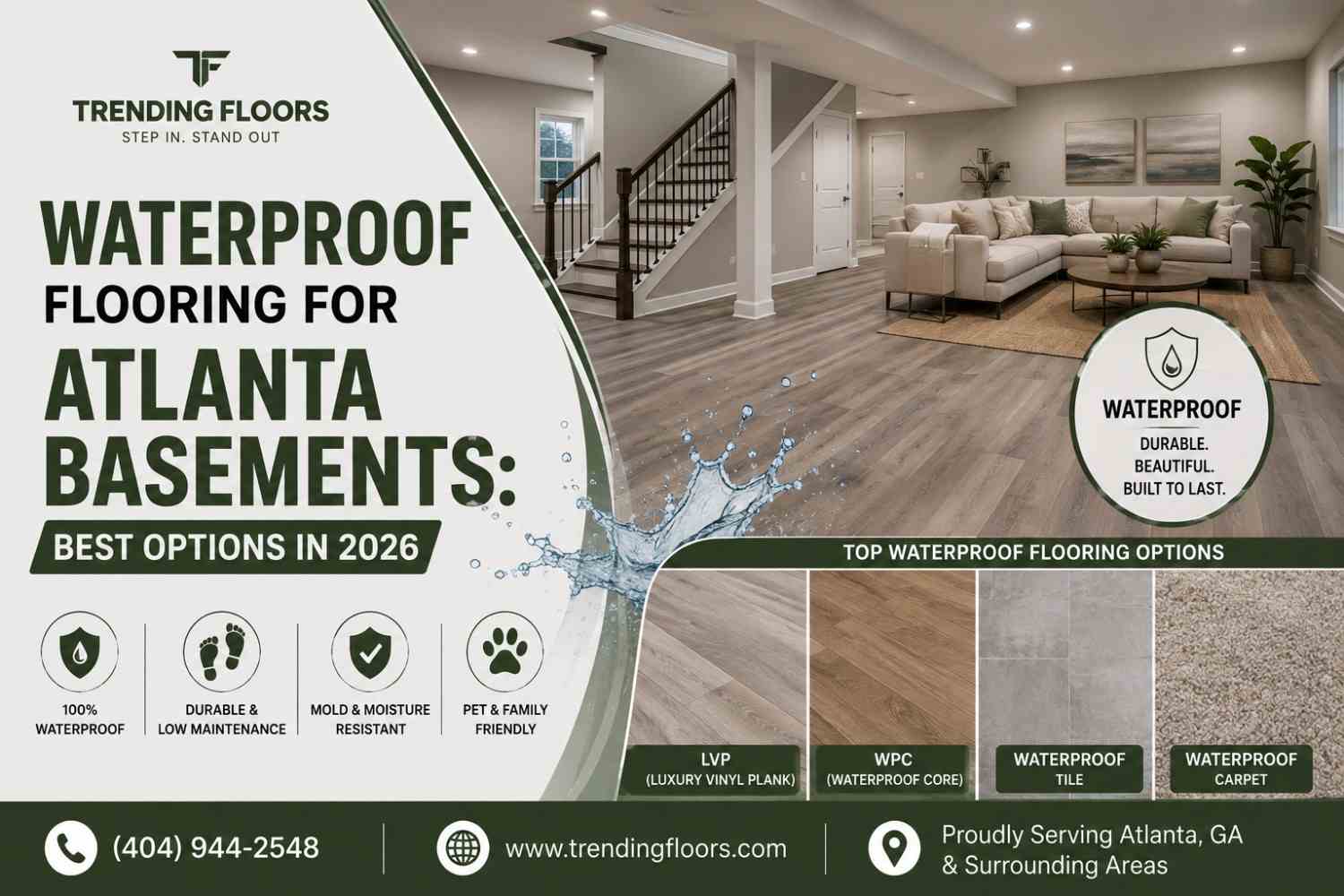
Luxury vinyl plank with a waterproof rigid core — either SPC (stone-plastic composite) or the premium hybrid rigid core format — is the correct choice for the majority of Atlanta finished basements. Its 100% waterproof construction handles both surface moisture events and the continuous moisture vapor transmission from Georgia’s basement slabs without any degradation. It installs directly over concrete without a moisture barrier requirement in most cases (though professional moisture testing before installation remains the correct practice regardless). And it delivers the warm, residential aesthetic that makes finished Atlanta basements feel like genuine living space rather than an afterthought.
The specification that matters in basement LVP is core density and thickness. Standard WPC core LVP — while comfortable underfoot — is slightly less dimensionally stable in the temperature and moisture fluctuations that characterize basement environments. SPC core or hybrid rigid core LVP is more appropriate for basement applications where temperature swings between summer air conditioning and winter heating cycles are significant.
Wide-plank waterproof LVP flooring in warm oak formats — 7″ to 9″ planks with matte finishes — is the dominant basement flooring specification across Metro Atlanta in 2026. It creates a visual continuity with main-floor LVP that makes finished basements feel like integrated living space, photographs well for home listings, and satisfies the aesthetic expectations of North Fulton County buyers who increasingly evaluate basement finish quality as part of their purchase decision.
For Atlanta homeowners who want the best-performing basement LVP available, hybrid rigid core flooring — which combines SPC-level dimensional stability with enhanced underfoot comfort and superior sound absorption — is the premium upgrade worth considering in basement media rooms, home offices, and finished living areas where comfort and noise management are priorities.
Porcelain Tile — The Most Durable Option for High-Moisture Basement Zones
For Atlanta basements with direct exterior access (walkout doors, daylight exposure), utility areas, basement bathrooms, and any zone where standing water exposure is a realistic possibility — porcelain tile is the most durable waterproof flooring available. Porcelain is genuinely impervious to moisture at any level of exposure, handles the heavy cleaning that basement utility areas require, and never develops the moisture-related structural failures that affect any organic flooring material over time in Georgia’s climate.
Large-format rectified porcelain (24″x24″ or larger) with epoxy grout — rather than standard cement grout — is the correct specification for Atlanta basement wet zones and exterior access areas. Epoxy grout seals the joints between tiles completely, eliminating the grout-line moisture penetration and staining that standard cement grout develops in high-moisture environments. The combination of large-format porcelain with epoxy grout at Atlanta basement entry points represents the most moisture-proof flooring assembly available in residential construction.
The practical limitation is comfort and temperature. Tile is cold and hard underfoot — which makes it the right choice for basement utility zones and bathrooms but a less comfortable specification for living areas, home offices, and media rooms where occupants spend extended time. The most effective Atlanta basement flooring strategy often combines tile at exterior access points and wet zones with LVP throughout the finished living areas.
Epoxy Flooring — The Right Choice for Home Gyms and Utility Basements
For Atlanta homeowners finishing a basement as a home gym, workshop, hobby space, or utility area — rather than as traditional living space — professional epoxy floor coating is the most appropriate and most durable option available. Epoxy creates a continuous, seamless, non-porous surface that is completely impervious to moisture vapor, handles heavy equipment, resists chemical spills and cleaning products, and maintains its appearance through the demanding use patterns of athletic and workshop environments.
The key distinction for Atlanta basements: professional epoxy systems installed with commercial-grade diamond grinding and moisture testing are fundamentally different from the DIY epoxy kits available at home improvement stores. Georgia’s humidity and basement moisture vapor transmission rates mean that epoxy applied without proper moisture testing and surface preparation will delaminate — often within months of installation. Professional systems with moisture-reactive primers handle elevated slab moisture conditions that would cause standard epoxy to fail.
Trending Floors installs professional epoxy flooring systems in Atlanta for basement home gyms, workshops, and utility spaces throughout Metro Atlanta. Our installations include concrete moisture testing, diamond grinding surface preparation, and commercial-grade coating systems with polyaspartic topcoats that handle Georgia’s humidity and temperature conditions reliably.
Carpet Tiles — Strategic Use in Specific Basement Applications
Broadloom carpet is not appropriate for Metro Atlanta basements — the moisture vapor conditions that characterize Georgia’s below-grade spaces create mold risk beneath traditional carpet padding within months of installation. This is non-negotiable.
Carpet tiles — specifically, modular carpet tiles with waterproof backing rather than standard carpet tile construction — are a legitimate option for Atlanta basement bedrooms, playrooms, and recreational areas where comfort and warmth are priorities. The waterproof backing prevents moisture vapor from penetrating through the tile to the concrete below, and the modular format allows individual tile replacement if moisture events occur rather than requiring full floor replacement.
The important caveat: even waterproof-backed carpet tiles should not be installed in Atlanta basements without professional moisture testing first. If vapor emission rates exceed acceptable levels, no carpet product — regardless of backing — is appropriate until moisture mitigation is addressed.
Engineered Hardwood — Use With Extreme Caution in Atlanta Basements
Engineered hardwood is frequently recommended for basements by contractors and flooring guides that don’t account for Georgia’s specific below-grade moisture conditions. While engineered hardwood performs significantly better than solid hardwood in humidity, it is water-resistant — not waterproof. In Metro Atlanta basements with typical moisture vapor emission rates, engineered hardwood is a calculated risk that many experienced Atlanta flooring contractors do not recommend.
The exception: daylight basements with excellent drainage, professional moisture mitigation systems, controlled HVAC environments, and verified low moisture vapor emission rates (below 3 lbs per 1,000 sq ft per 24 hours on calcium chloride testing) may be appropriate candidates for engineered hardwood with a floating installation and vapor barrier. This requires professional moisture testing, not assumption — and the decision should be made with full understanding that the floor will require prompt attention to any moisture event to prevent irreversible damage.
For most Atlanta homeowners, the risk-adjusted comparison between engineered hardwood and premium LVP in a basement application consistently favors LVP — the performance gap in a basement environment doesn’t justify the additional cost and maintenance requirements of engineered wood.
Moisture Testing — The Non-Negotiable First Step for Every Atlanta Basement
Professional moisture testing before any flooring installation is standard practice in Metro Atlanta’s basement market — and it is genuinely non-negotiable, regardless of how dry a basement appears or how long it has been finished. Concrete slab moisture vapor emission changes seasonally, responds to rainfall events, and varies based on soil conditions that are not visible or predictable without testing.
There are two primary testing methods for basement concrete slabs. The calcium chloride test measures moisture vapor emission rate over a 60–72 hour period and produces a result in pounds of moisture per 1,000 square feet per 24 hours. Most flooring manufacturers specify maximum acceptable calcium chloride test results for their products. The RH (relative humidity) in-situ probe test measures moisture within the slab itself and is considered more accurate for long-term moisture prediction. The National Wood Flooring Association recommends RH probe testing for any wood or engineered wood installation over concrete — including basement applications.
If testing reveals elevated moisture levels — common in Gwinnett County’s flat terrain and in homes near drainage features — moisture mitigation must be addressed before flooring installation. Options include topical moisture barriers applied to the slab surface, moisture-reactive epoxy primers, or in severe cases, drainage mat systems that create a vapor break between the slab and the flooring. The cost of proper moisture mitigation ($300–$1,500 depending on severity and square footage) is always less than the cost of replacing a failed basement floor.
Basement Flooring Costs in Atlanta (2026)
Atlanta basement flooring costs vary by material, square footage, moisture mitigation requirements, and whether an existing floor needs to be removed first. Realistic 2026 ranges for Metro Atlanta basement projects:
- LVP (SPC core, 20-mil) installed: $5–$9 per square foot
- Hybrid rigid core installed: $8–$12 per square foot
- Porcelain tile installed: $9–$16 per square foot
- Professional epoxy floor system installed: $6–$14 per square foot
- Waterproof-backed carpet tile installed: $5–$9 per square foot
- Moisture testing (calcium chloride + RH probe): $200–$500
- Moisture mitigation treatment: $300–$1,500 additional if needed
- Old flooring removal (carpet, tile, existing LVP): $0.75–$2.00 per square foot additional
A typical Atlanta finished basement flooring project (600–1,200 square feet) runs between $4,500 and $15,000 depending on material selection, moisture conditions, and subfloor preparation requirements. Basements that require moisture mitigation before installation add $300–$1,500 to the project total — a cost that is always worth paying to protect the flooring investment above it.
How to Choose a Flooring Contractor for Your Atlanta Basement
Basement flooring in Metro Atlanta requires contractor experience that not every flooring installer has. When evaluating contractors for a basement project, ask specifically about their basement installation experience in Georgia’s climate — not just their general flooring portfolio.
Key questions for basement projects: Do they test for moisture before recommending any material? What testing method do they use — calcium chloride, RH probe, or moisture meter only? (Moisture meter alone is not sufficient for basement slab assessment.) Do they offer moisture mitigation services if needed, or do they refer this out? Can they show examples of basement projects they’ve completed in Metro Atlanta homes?
Trending Floors provides professional flooring installation across Atlanta including basement projects throughout Gwinnett County, North Fulton County, and Metro Atlanta. We perform moisture testing on every basement project before recommending any material, offer moisture mitigation services for elevated vapor conditions, and provide written estimates that include every cost component — including moisture assessment and mitigation — before work begins.
Frequently Asked Questions — Waterproof Flooring for Atlanta Basements
For additional questions about flooring materials, installation timelines, and costs, visit our Atlanta flooring FAQ — covering the most common questions from Metro Atlanta homeowners.
What is the best waterproof flooring for an Atlanta basement?
For most Atlanta finished basements, SPC core LVP with a 20-mil or thicker wear layer is the best all-around choice. It is 100% waterproof through the core, handles Georgia’s basement moisture vapor conditions without any degradation, installs directly over concrete, and delivers a warm residential aesthetic that makes finished basements feel like genuine living space. Porcelain tile is the better choice for exterior access points, basement bathrooms, and utility zones where direct moisture exposure is higher. Professional epoxy is the right choice for home gyms, workshops, and utility spaces where seamless, chemical-resistant surfaces are required.
Is laminate flooring safe for Atlanta basements?
No — standard laminate is not appropriate for Metro Atlanta basements. Laminate is water-resistant, not waterproof — it will swell, buckle, and delaminate at the seams under the sustained moisture vapor emission from Georgia’s below-grade concrete slabs. This is one of the most common and most expensive basement flooring mistakes Atlanta homeowners make. Waterproof LVP is the correct alternative that delivers a similar aesthetic at comparable or lower cost without the moisture vulnerability.
Do I need moisture testing before installing basement flooring in Atlanta?
Yes — always, regardless of how dry the basement appears. Concrete slab moisture vapor emission is continuous and invisible, and rates vary significantly across Metro Atlanta based on soil conditions, proximity to water features, and seasonal factors. Professional moisture testing (calcium chloride or RH probe — not moisture meter alone) is the only reliable way to confirm whether a basement slab is within acceptable limits for your chosen flooring material. Skipping this step in Georgia’s climate is one of the most consistent predictors of premature basement floor failure.
Can you install LVP directly over a basement concrete slab in Atlanta?
Yes — with professional moisture testing first. LVP’s waterproof core means it does not require a vapor barrier between the slab and the flooring in most installations, unlike wood products. However, moisture testing is still required to confirm that vapor emission rates are within the LVP manufacturer’s specified limits. Elevated moisture levels should be addressed with a moisture mitigation primer or topical barrier before LVP installation, even though LVP itself is waterproof — excessive vapor can affect adhesive performance in glue-down installations and create conditions for mold growth in the gap between slab and flooring if not managed.
How much does basement flooring cost in Atlanta in 2026?
Atlanta basement flooring runs $5–$9 per square foot for SPC LVP, $8–$12 for hybrid rigid core, $9–$16 for porcelain tile, and $6–$14 for professional epoxy — all installed. A typical Atlanta finished basement (600–1,200 sq ft) runs $4,500–$15,000 depending on material and moisture conditions. Moisture testing adds $200–$500. Moisture mitigation, if needed, adds $300–$1,500. These preparation costs are always worth investing — they protect the flooring above them from the failure modes that are common in Metro Atlanta’s basement environments.
What flooring should I avoid in an Atlanta basement?
Three materials should not be used in Metro Atlanta basements under normal conditions. Solid hardwood — absorbs moisture vapor from concrete slabs and will cup, gap, or buckle. Standard laminate — swells and delaminates under sustained moisture vapor conditions common to Georgia’s below-grade spaces. Broadloom carpet with standard padding — traps moisture vapor beneath the pad and creates mold conditions within months in most Atlanta basements. All three are frequently installed in Atlanta basements by inexperienced contractors and routinely fail within two to five years.
Is engineered hardwood a good choice for an Atlanta basement?
In most cases, no — the moisture risk is too high for the typical Metro Atlanta basement. Engineered hardwood is water-resistant, not waterproof, and performs significantly better than solid hardwood in humidity. However, Georgia’s basement moisture vapor conditions exceed what engineered hardwood handles reliably without a controlled, low-moisture environment verified by professional testing. The risk-adjusted comparison between premium LVP and engineered hardwood in an Atlanta basement almost always favors LVP — equivalent aesthetic quality, lower cost, and zero moisture risk versus meaningful moisture risk and higher cost.
Get a Free Basement Flooring Estimate in Atlanta
Trending Floors installs waterproof flooring in finished basements throughout Metro Atlanta — Lawrenceville, Alpharetta, Johns Creek, Sandy Springs, Roswell, and the broader Gwinnett and Fulton County areas. We test every basement slab for moisture before recommending any material, provide moisture mitigation services where needed, and deliver written estimates covering every cost component including preparation and testing.
Book your free basement flooring consultation in Atlanta today and get honest local advice from a contractor who understands Georgia’s below-grade moisture conditions.
About Trending Floors
Trending Floors is a licensed and insured flooring contractor based at 465 Maltbie Street, Suite 240, Lawrenceville, GA 30046, serving Metro Atlanta homeowners since 2018. We install LVP, hybrid rigid core, tile, epoxy, carpet, and engineered hardwood flooring — all with our own trained crews, professional moisture testing, written estimates, and workmanship warranties on every project.
(404) 944-2548 | estimates@trendingfloors.com | Mon–Sat 8am–6pm