
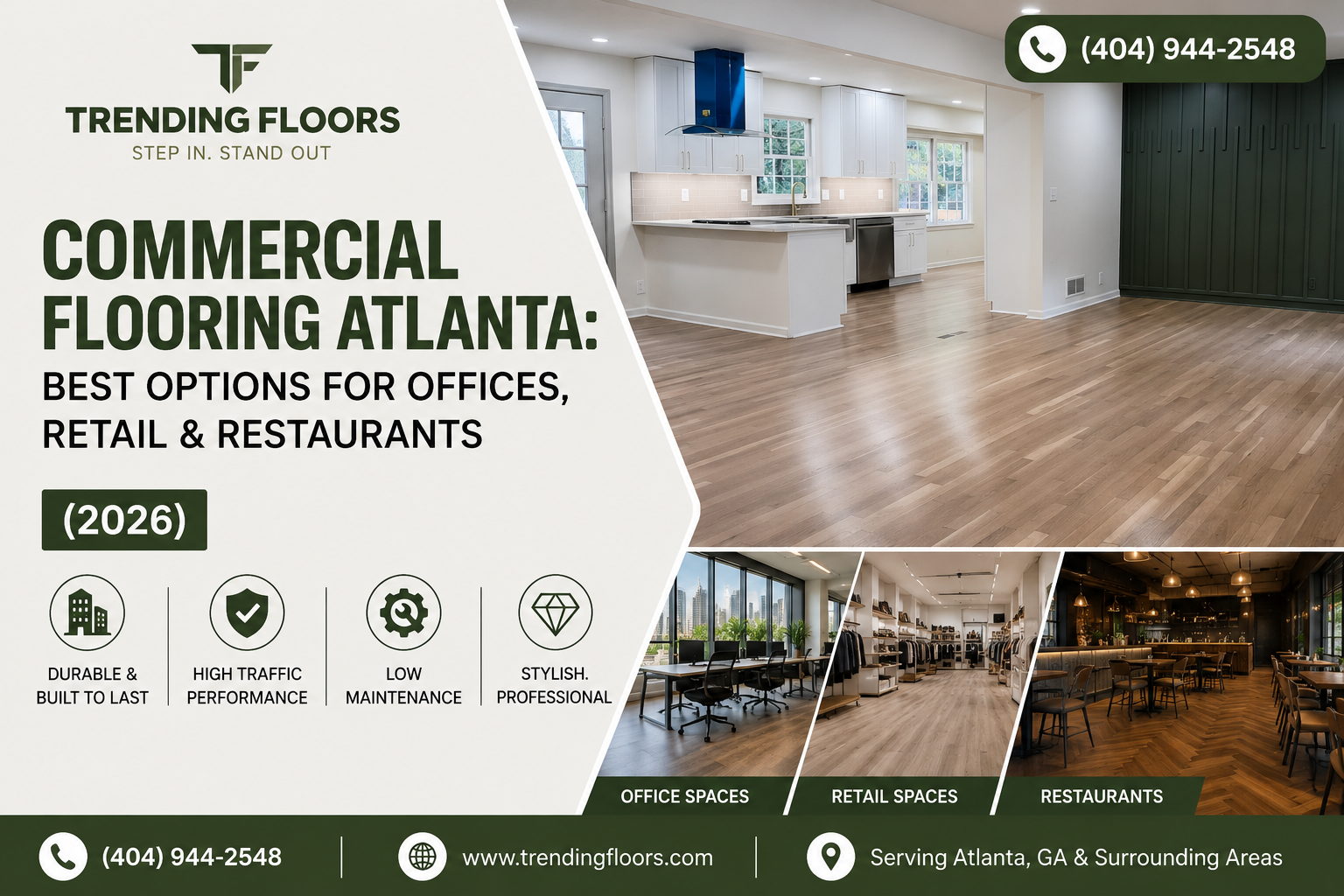
Commercial flooring Atlanta is not a single decision — it is a series of decisions that compound into either a smart long-term investment or an expensive recurring problem. The flooring that works in a Midtown law firm’s reception area is not the flooring that belongs in a Buckhead restaurant kitchen or a Gwinnett County retail showroom. Each environment has its own traffic volume, moisture exposure, maintenance requirements, and aesthetic expectations — and each of those variables narrows the field of appropriate materials considerably.
This guide is built for Atlanta business owners, property managers, and commercial landlords who need a straight answer on which flooring materials actually perform in which commercial environments — with realistic 2026 cost ranges, installation timelines, and the specific considerations that apply to Metro Atlanta’s commercial market.
What Makes Commercial Flooring Different from Residential in Atlanta
The core difference between commercial and residential flooring is not just durability — it is the combination of durability, maintainability, installation speed, and total cost of ownership over a 10-to-20-year horizon. A flooring choice that looks reasonable at installation cost can be significantly more expensive over its lifecycle if it requires frequent professional cleaning, causes customer safety issues, or needs replacement in five years instead of fifteen.
Atlanta-Specific Commercial Considerations
Several factors specific to Metro Atlanta’s commercial market shape the right flooring decision for local businesses.
Concrete slab subfloors are nearly universal in commercial Atlanta. Unlike some older commercial markets with wood-frame construction, virtually all Metro Atlanta commercial properties — office buildings, retail strips, restaurants, and mixed-use developments — sit on concrete slab foundations. This eliminates solid hardwood as a practical commercial option and makes moisture testing before any installation non-negotiable, regardless of material.
Georgia’s humidity affects commercial spaces the same way it affects homes. Businesses that prop open loading dock doors, run high-volume HVAC systems cycling between indoor air and Georgia’s summer humidity, or have kitchens and wet service areas create moisture conditions that demand waterproof or highly moisture-resistant flooring throughout — not just in explicitly wet zones.
Atlanta’s commercial market is growing fast. Metro Atlanta added over 60,000 new businesses between 2020 and 2024, with significant commercial development concentrated in Gwinnett County, Buckhead, Midtown, and the Alpharetta/Johns Creek technology corridor. New commercial tenants in these areas frequently need flooring that can be installed quickly during tenant build-out periods — minimizing downtime and getting businesses operational on schedule.
Best Flooring for Atlanta Offices
What Office Flooring in Atlanta Needs to Do
Office flooring in Metro Atlanta must handle moderate-to-heavy daily foot traffic, rolling office chairs, the noise demands of open-plan work environments, and the maintenance realities of commercial cleaning crews. It also needs to project the right aesthetic for clients and employees — a detail that matters more in Atlanta’s competitive commercial real estate market than many business owners initially account for.
Commercial LVP — The Leading Choice for Atlanta Offices
Commercial-grade luxury vinyl plank is the dominant flooring choice for Atlanta offices in 2026 — and it has earned that position. Commercial LVP differs from residential LVP primarily in wear layer thickness: where residential products typically run 12–20 mil, commercial-grade LVP starts at 20 mil and extends to 28 mil or above for the highest-traffic applications. That additional wear layer thickness is what allows commercial LVP to hold up under rolling chairs, high foot traffic, and daily cleaning with commercial-grade products without surface degradation.
For Atlanta offices specifically, commercial LVP flooring offers a compelling combination: it installs over concrete slabs without moisture concerns that affect wood products, it is available in wide-plank formats that suit contemporary open office aesthetics, and it can be installed overnight or over a weekend to minimize business disruption. Replacement of individual planks — without disturbing the surrounding floor — is also possible with floating installation systems, which reduces long-term maintenance costs significantly compared to glue-down hardwood or carpet tiles.
Commercial Carpet Tile — Best for Acoustic Management
For offices where sound management is a priority — open-plan layouts, call centers, collaborative workspaces, and multi-tenant office buildings — commercial carpet tile remains a strong choice. Unlike broadloom carpet, carpet tiles allow individual replacement of damaged or stained sections without full floor replacement, which dramatically reduces the long-term cost of maintaining carpet in a commercial environment.
Solution-dyed nylon is the fiber standard for commercial carpet tile — it handles heavy traffic, commercial cleaning chemicals, and the recurring compression of office chairs better than polyester alternatives. Modular carpet tile also allows pattern and color customization that can reinforce brand identity in reception areas and collaborative zones.
Engineered Hardwood — Premium Option for High-End Atlanta Offices
For law firms, financial services offices, executive suites, and professional services businesses in Buckhead, Midtown, and the Alpharetta technology corridor where the aesthetic impression of real wood matters, commercial-grade engineered hardwood is the premium option. It delivers the warmth and authority of genuine wood flooring — which no vinyl product fully replicates at close inspection — while handling Atlanta’s slab foundations and humidity far better than solid hardwood.
The trade-off is cost and maintenance requirements. Engineered hardwood in commercial applications costs significantly more than LVP, requires periodic refinishing (though less frequently than solid wood), and demands prompt cleanup of spills and tracked-in moisture. It is the right choice where the aesthetic investment is justified by the business context — not the default choice for every office environment.
Best Flooring for Atlanta Retail Spaces
What Retail Flooring in Atlanta Needs to Do
Retail flooring in Metro Atlanta faces some of the most demanding conditions of any commercial application. High foot traffic concentrated in specific pathways, shopping carts and display fixtures, Georgia red clay tracked in from parking lots, spills from food and beverage retail, and the constant visual scrutiny of customers who make purchase decisions partly based on how a space feels — retail flooring must perform on every dimension simultaneously.
Rigid-Core LVP and Porcelain Tile — The Retail Standard
The dominant retail flooring strategy across Metro Atlanta in 2026 combines rigid-core LVP on sales floor areas with large-format porcelain tile at entries, cash wrap zones, and high-moisture areas. This combination delivers the warmth and visual interest of LVP in the areas where customers spend time browsing, while providing the virtually indestructible durability of porcelain tile at the points of highest wear and moisture exposure.
For retail entry zones — the first 6–10 feet inside any Atlanta retail space — commercial porcelain tile flooring is the only practical choice. Georgia’s red clay, summer rain, and the constant traffic of a retail entry create conditions that degrade carpet, scratch LVP, and eventually show wear on even the most durable surfaces. Large-format rectified porcelain (24″x24″ or larger) with epoxy grout at entries resists staining, cleans quickly between customers, and holds its appearance for decades under commercial use.
Epoxy Flooring — Warehouses, Showrooms, and High-Traffic Back-of-House
For retail businesses with warehouse areas, showroom floors where heavy merchandise is moved, or back-of-house environments that need seamless, chemical-resistant surfaces, professional epoxy coating is the commercial standard. Epoxy creates a continuous, non-porous surface that resists impact, chemical spills, forklift traffic, and power washing — durability no modular flooring product can match in truly demanding commercial applications.
Trending Floors installs commercial epoxy flooring in Atlanta for showrooms, warehouses, auto dealerships, and retail back-of-house environments throughout Metro Atlanta. Professional epoxy systems with polyaspartic topcoats are UV-stable — important for Atlanta showrooms and retail spaces with significant natural light exposure — and can be completed over a weekend to minimize business disruption.
Best Flooring for Atlanta Restaurants and Hospitality Spaces
What Restaurant Flooring in Atlanta Needs to Do
Restaurant flooring faces the most demanding conditions of any commercial application: constant moisture exposure, food and beverage spills, commercial kitchen cleaning chemicals, heavy rolling equipment, grease accumulation, and the need for slip resistance that protects both staff and customers. In Georgia, the combination of outdoor humidity tracking in through restaurant entries and the intense cleaning cycles of commercial kitchens creates conditions that eliminate most flooring options quickly.
Restaurant flooring also has a direct regulatory dimension. Georgia Department of Public Health commercial kitchen inspections evaluate floor surfaces for cleanliness, integrity, and appropriate slip resistance. Flooring that traps grease, develops cracks, or lacks adequate DCOF (Dynamic Coefficient of Friction) ratings is a compliance issue — not just an aesthetic one.
Porcelain Tile — The Non-Negotiable Choice for Kitchen Areas
In any Atlanta restaurant kitchen, walk-in cooler, prep area, or service corridor, porcelain tile with a minimum 0.42 DCOF (wet) rating is the industry standard and the Georgia health code expectation. Porcelain is genuinely impervious to the moisture, grease, and chemical cleaning cycles that commercial kitchens require. Epoxy grout — rather than standard cement grout — is essential in kitchen tile applications to prevent grease and bacteria from penetrating grout lines.
Large-format porcelain (12″x24″ or 24″x24″) reduces the number of grout lines — which means less grout to maintain, less area for bacteria to accumulate, and faster cleaning. This is the single most important specification decision in Atlanta restaurant kitchen flooring.
Front-of-House: LVP and Tile Combinations
Front-of-house restaurant flooring in Atlanta needs to balance durability with the aesthetic that defines the dining experience. The combination that works best across most Metro Atlanta restaurant concepts in 2026: large-format porcelain tile at the entry and bar areas (maximum moisture and traffic) transitioning to wide-plank commercial LVP in dining areas where the warmth of a wood-look surface enhances the ambiance.
For Atlanta restaurant concepts where the aesthetic calls for genuine hardwood — farm-to-table concepts, upscale dining rooms, wine bars — commercial-grade engineered hardwood in a hard species with a commercial aluminum oxide finish is the only viable wood option. Solid hardwood in a restaurant environment is not appropriate: the moisture, humidity swings, and cleaning cycles will cause failure within years regardless of finish quality.
Commercial Flooring Costs in Atlanta (2026)
Commercial flooring costs in Metro Atlanta vary significantly by material, square footage, subfloor condition, and installation complexity. Here are realistic 2026 ranges for commercial projects:
- Commercial LVP (20–28 mil wear layer) installed: $5–$10 per square foot
- Commercial carpet tile installed: $4–$9 per square foot
- Porcelain tile installed (commercial grade): $9–$16 per square foot
- Commercial engineered hardwood installed: $9–$16 per square foot
- Professional epoxy flooring system installed: $6–$14 per square foot depending on system type and square footage
- Subfloor leveling (commercial): $3–$7 per square foot additional if needed
- After-hours or weekend installation premium: 15–25% additional over standard day-rate pricing
Commercial projects over 2,000 square feet typically benefit from volume pricing — per-square-foot costs decrease as project size increases. Most Atlanta commercial flooring projects for a full office suite or retail space (1,500–3,000 sq ft) run between $12,000 and $45,000 depending on material selection and subfloor condition.
Minimizing Downtime During Commercial Flooring Installation in Atlanta
For operating Atlanta businesses, installation downtime is a real cost that belongs in the total project calculation. Here is what to expect and how to manage it across different material types:
LVP and Carpet Tile
Commercial LVP and carpet tile are the fastest commercial flooring installations available. A 2,000 square foot office floor can typically be completed in one to two nights of after-hours work, with the space fully operational the following business morning. This is why LVP dominates Atlanta’s commercial tenant improvement market — speed of installation that doesn’t interrupt business operations.
Porcelain Tile
Tile installation is slower due to setting and curing times. A 1,000 square foot tile area typically requires two to three days — plus 24 hours of cure time before foot traffic. Commercial restaurant kitchen tile installations are typically scheduled during a planned closure or phased by section to keep partial operations running.
Epoxy Flooring
Professional polyaspartic epoxy systems can be completed in one day with light foot traffic possible within 24 hours and full commercial use within 48–72 hours. Traditional epoxy systems require two to four days. For Atlanta businesses that need minimum downtime, polyaspartic systems are worth the premium.
How to Choose a Commercial Flooring Contractor in Atlanta
Commercial flooring is not a residential project at larger scale — it involves different subfloor requirements, different product specifications, different installation methods, and different timeline pressures. When evaluating contractors for a commercial project, ask specifically about their commercial installation experience, not just their residential portfolio.
Key questions for commercial projects: Do they carry commercial general liability coverage at appropriate limits for your property? Have they completed projects in similar commercial environments (office, restaurant, retail)? Can they work after hours or on weekends to minimize business disruption? Do they provide a written warranty that covers both materials and commercial installation workmanship?
Trending Floors provides professional flooring installation across Atlanta for both residential and commercial projects, with after-hours and weekend scheduling available for businesses that cannot afford daytime operational disruption.
Frequently Asked Questions — Commercial Flooring in Atlanta GA
For additional questions about flooring materials, costs, and installation timelines, visit our Atlanta flooring FAQ — covering the most common questions from Atlanta homeowners and business owners alike.
What is the best flooring for a commercial office in Atlanta?
Commercial-grade LVP with a 20-mil or thicker wear layer is the most practical choice for most Atlanta offices in 2026. It handles concrete slab subfloors without moisture concerns, installs quickly to minimize business disruption, supports rolling office chairs without surface degradation, and is available in wide-plank formats that suit contemporary office aesthetics. Commercial carpet tile is the better choice where acoustic management and comfort are priorities. Engineered hardwood is the premium option for law firms, financial services offices, and executive suites where real wood aesthetics justify the higher cost.
What flooring is required for restaurant kitchens in Atlanta?
Georgia Department of Public Health guidelines for commercial kitchens require flooring that is smooth, non-absorbent, and cleanable — porcelain tile with a wet DCOF rating of 0.42 or higher is the industry standard that meets these requirements. Epoxy grout is required in kitchen tile applications to prevent bacteria from penetrating grout lines. Large-format porcelain (12″x24″ minimum) with minimal grout lines is the recommended specification for Atlanta restaurant kitchens.
How much does commercial flooring cost in Atlanta in 2026?
Commercial flooring in Atlanta runs $4–$16 per square foot installed depending on material. Commercial LVP costs $5–$10 per square foot installed. Porcelain tile and commercial engineered hardwood both run $9–$16 per square foot. Professional epoxy systems cost $6–$14 per square foot depending on system type and project size. A full commercial space of 1,500–3,000 sq ft typically runs $12,000–$45,000 installed. After-hours or weekend installation carries a 15–25% premium.
How long does commercial flooring installation take in Atlanta?
LVP and carpet tile are the fastest commercial installations — a 2,000 sq ft office floor can typically be completed overnight. Tile installations require two to three days plus cure time. Epoxy polyaspartic systems can be completed in one day with light use possible within 24 hours. Most Atlanta commercial flooring contractors can schedule after-hours or weekend installations to minimize business downtime — ask specifically about this during your estimate.
Can commercial flooring be installed over existing floors in Atlanta?
In some cases, yes — floating LVP can be installed over existing smooth, level, well-bonded commercial flooring without full removal. However, this adds height at transitions and may require subfloor leveling if the existing surface is uneven. Old glue-down tile, particularly pre-1980s tile that may contain asbestos, requires professional assessment and potentially abatement before any new flooring is installed. A thorough subfloor assessment is required before any commercial installation decision is made.
Does Atlanta’s climate affect commercial flooring choices?
Yes, in two significant ways. First, virtually all Metro Atlanta commercial spaces sit on concrete slab foundations that emit moisture vapor — making moisture testing and appropriate product selection critical for any installation. Second, Georgia’s red clay and summer humidity mean that commercial entries require particularly durable, easy-to-clean surfaces. Large-format porcelain tile with epoxy grout at commercial entries is the standard solution across the Atlanta market.
What is the most durable commercial flooring for high-traffic Atlanta spaces?
For the highest-traffic commercial applications — retail sales floors, restaurant dining areas, building lobbies, and multi-tenant hallways — commercial rigid-core LVP with a 28-mil wear layer and porcelain tile at critical entry and wet zones represent the most durable and cost-effective combination available in Atlanta’s 2026 commercial market. Professional epoxy systems are the most durable option for warehouses, showrooms, and commercial kitchens where seamless, chemical-resistant surfaces are required.
Get a Free Commercial Flooring Estimate in Atlanta
Trending Floors provides commercial flooring installation across Metro Atlanta — offices, retail spaces, restaurants, showrooms, medical suites, and multi-tenant properties in Lawrenceville, Alpharetta, Johns Creek, Sandy Springs, Roswell, Buckhead, Midtown, and Gwinnett County. We offer after-hours and weekend installation scheduling, written itemized estimates, and commercial workmanship warranties on every project.
Book your free commercial flooring consultation in Atlanta today and get a written estimate from a licensed, insured local contractor who understands Atlanta’s commercial market.
About Trending Floors
Trending Floors is a licensed and insured flooring contractor based at 465 Maltbie Street, Suite 240, Lawrenceville, GA 30046. We serve commercial and residential clients across Metro Atlanta including Lawrenceville, Alpharetta, Johns Creek, Sandy Springs, Roswell, and Atlanta. Licensed. Insured. Local. Commercial and residential flooring installation backed by written workmanship warranties.
(404) 944-2548 | estimates@trendingfloors.com | Mon–Sat 8am–6pm