If you’re upgrading the floors in your Atlanta home and you want real wood, you’re going to face one decision before anything else: engineered hardwood or solid hardwood? Both are genuine wood products. Both look beautiful. Both add real value to a home. But they perform very differently in Georgia’s climate — and in the concrete slab homes that make up the majority of Metro Atlanta’s housing stock.
This guide gives Atlanta homeowners a straight, complete comparison — construction, performance in Georgia’s humidity, slab compatibility, cost, refinishability, and resale value. No manufacturer spin. Just the information you need to make the right call for your specific home.
What Is the Difference Between Engineered and Solid Hardwood?
The most important thing to understand is that both products contain real wood. Neither is fake, laminate, or vinyl. The difference is in how the plank is constructed — and that construction difference is what drives every other performance difference between them.
Solid Hardwood — Construction and Characteristics
Solid hardwood is exactly what the name says: a plank milled from a single, solid piece of lumber from top to bottom. Standard thickness is ¾ inch (19mm). Because it is one homogenous piece of wood, it expands and contracts as a single unit in response to changes in moisture and temperature.
That movement is the defining characteristic of solid hardwood — and the source of both its greatest strength and its biggest limitation. The full ¾-inch thickness means solid hardwood can be sanded and refinished many times over its lifetime — typically 5 to 10 full refinishing cycles — giving it a potential lifespan of 50 to 100 years in the right conditions. But that same wood movement means it is sensitive to humidity, incompatible with concrete slabs, and requires stricter environmental controls than engineered alternatives.
Engineered Hardwood — Construction and Characteristics
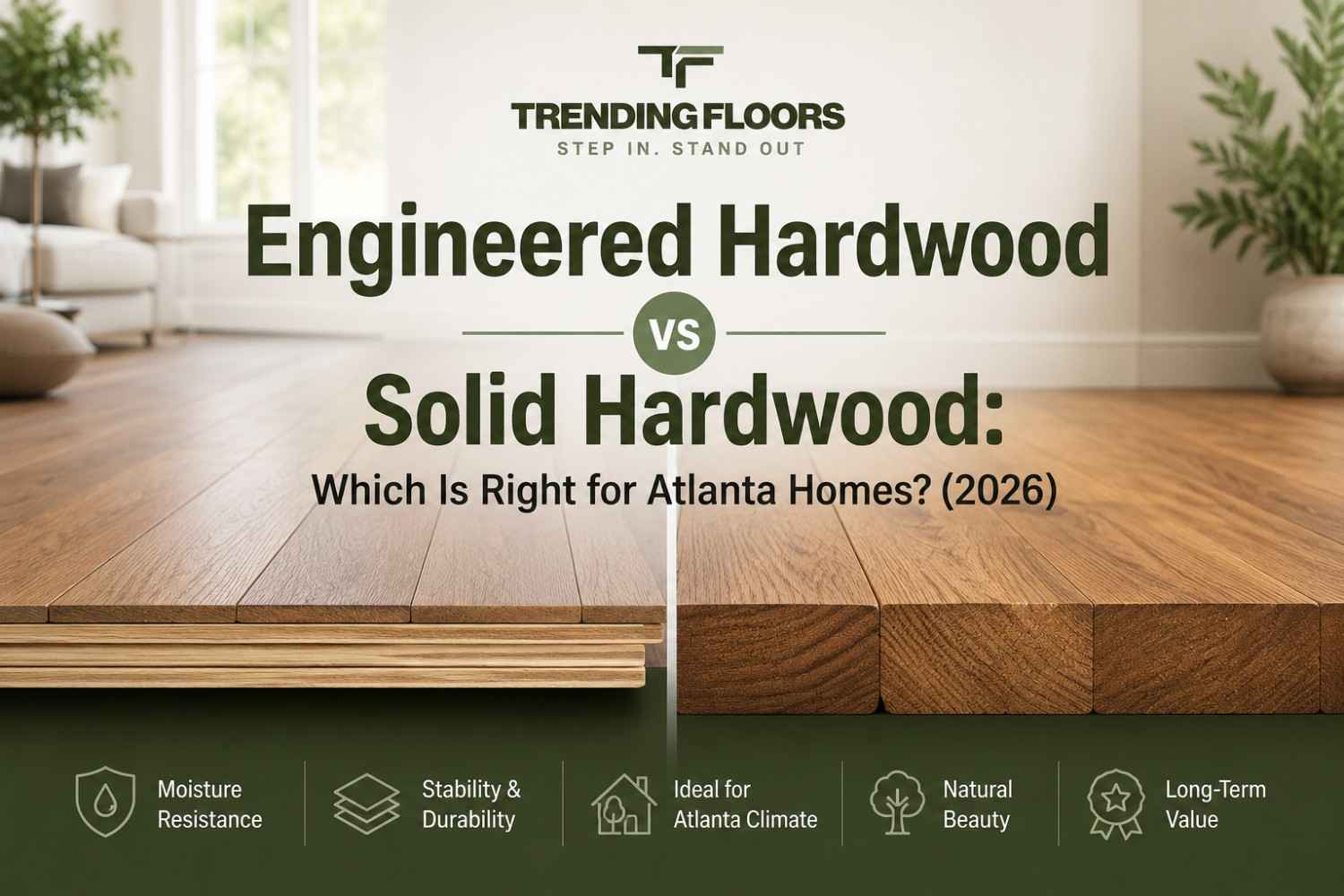
Engineered hardwood is built from multiple layers bonded together: a real hardwood veneer on top — the visible surface — over a core of high-quality plywood or composite material. The layered cross-ply construction is specifically designed to counteract wood’s natural tendency to move with moisture changes. Because each layer runs in a different direction, the planks resist expansion and contraction far more effectively than a solid plank of the same species.
The wear layer — the hardwood veneer on top — ranges from 1mm in budget products to 3mm–6mm in premium engineered flooring. The thickness of this wear layer determines how many times the floor can be refinished. A 3mm wear layer typically allows one to two refinishing cycles. A 6mm layer can handle three to four. Premium engineered hardwood from quality manufacturers now comes with wear layers thick enough that most homeowners will never refinish them more than once or twice in the floor’s lifetime — which, according to the National Wood Flooring Association, is consistent with how most homeowners actually use their floors regardless of product type.
Why Atlanta’s Climate Makes This Decision Critical
Georgia’s humid subtropical climate is not incidental to this comparison — it is the central factor. Atlanta experiences relative humidity fluctuations between 30% and 75% throughout the year, with summer highs routinely exceeding 70% humidity during the June–September rainy season and drier periods in winter dropping to 35–40%.
That 40-percentage-point swing across the year causes solid hardwood to expand measurably in summer and contract in winter. In a well-maintained home with consistent HVAC operation and humidity control kept between 35% and 55% — the range the NWFA recommends for hardwood floors — solid hardwood can be managed successfully. But in homes without consistent climate control, in rooms with significant temperature variation, or in any installation over concrete, that movement becomes a serious risk.
The Slab Foundation Problem
This is where the Atlanta market diverges sharply from national flooring advice. The majority of Metro Atlanta homes — particularly those built after 1970 in Gwinnett, Fulton, Cobb, and DeKalb counties — sit on concrete slab foundations. Concrete is porous. It emits moisture vapor continuously, even when it feels completely dry on the surface.
Solid hardwood installed directly over a concrete slab will absorb that moisture vapor from below. Over months and years, this causes cupping (edges of planks rise higher than the center), gapping between planks, and in severe cases buckling where planks lift entirely from the subfloor. Professional flooring contractors in the Atlanta market see this failure mode regularly — almost always the result of solid hardwood being installed over concrete by a contractor who didn’t understand local construction conditions or didn’t perform moisture testing.
Engineered hardwood’s layered construction makes it dramatically more stable over concrete. With proper subfloor preparation — including moisture testing, any needed moisture mitigation treatment, and a vapor barrier where required — engineered hardwood performs reliably on Atlanta slabs. It is the product the majority of experienced Atlanta flooring contractors recommend for slab-on-grade homes, and it accounts for approximately 65% of Georgia’s hardwood flooring market for exactly this reason.
Head-to-Head Comparison: Every Factor That Matters
Moisture and Humidity Performance
Engineered hardwood wins clearly. The cross-ply core construction resists moisture-driven expansion and contraction far better than solid hardwood. In Atlanta’s 30–75% annual humidity range, engineered hardwood maintains dimensional stability that solid hardwood simply cannot match without constant environmental management.
Slab Foundation Compatibility
Engineered hardwood wins clearly. Solid hardwood should not be installed directly over concrete. Engineered hardwood — with proper moisture testing and preparation — installs safely over concrete slabs using either a floating or glue-down method. For the majority of Metro Atlanta homes that sit on slabs, this difference alone determines the correct choice.
Refinishability and Longevity
Solid hardwood wins — with conditions. Solid hardwood’s ¾-inch thickness allows 5–10 refinishing cycles and a potential lifespan of 50–100 years in stable environments. Engineered hardwood with a 3mm wear layer allows 1–2 refinishes; a 6mm layer allows 3–4. In practical terms, this means solid hardwood has a higher ceiling for longevity — but only in homes where environmental conditions allow it to perform without moisture problems. An engineered floor that lasts 30–50 years without issues outperforms a solid floor that develops moisture-related problems within five years.
Wide Plank Availability
Engineered hardwood wins. Solid hardwood planks are typically limited to 5-inch widths because wider solid planks have an extremely high risk of cupping and movement. Engineered hardwood’s stable core allows planks up to 10–12 inches wide without the same risk — which is why the wide-plank look that dominates Atlanta’s 2026 design trends is almost exclusively achieved with engineered products.
Installation Flexibility
Engineered hardwood wins. Solid hardwood requires a wood subfloor for nail-down installation — it cannot go over concrete without significant additional work. Engineered hardwood installs over concrete (glue-down or floating), over existing floors in many cases, and on any level of the home including basements. This flexibility makes it suitable for the full range of Atlanta home types and configurations.
Cost
Engineered hardwood is typically lower to equal in cost. In 2026 Atlanta pricing:
- Engineered hardwood installed: $7–$14 per square foot
- Solid hardwood installed: $9–$16 per square foot
Premium engineered hardwood with thick wear layers can approach or equal solid hardwood pricing. The installation cost for solid hardwood is also typically higher due to the additional labor involved in nail-down installation and the stricter subfloor requirements. Over a 1,000 square foot project, homeowners often save $2,000–$5,000 choosing engineered over solid hardwood at comparable quality levels.
Resale Value
Both perform well — the gap is narrowing. According to the National Association of Realtors, hardwood flooring delivers approximately a 118% return on investment at resale, with homeowners typically recouping 70–80% of installation costs. Historically, solid hardwood carried a premium perception among buyers. In 2026, that distinction has largely closed — Atlanta buyers increasingly focus on quality and appearance rather than construction method. Wide-plank engineered hardwood in premium species is widely accepted — and often preferred — by contemporary buyers across Metro Atlanta. In established neighborhoods like Druid Hills, Ansley Park, and Virginia-Highland where historic character matters, solid hardwood still carries a slight premium perception. In newer North Atlanta communities, engineered hardwood is the norm and buyers expect it.
Which Species Should You Choose?
Species selection matters as much as the solid vs. engineered decision — particularly for scratch resistance and long-term appearance. The Janka hardness scale measures wood’s resistance to surface denting and wear. Here are the most popular Atlanta choices:
- White Oak: 1,360 lbf Janka — the most popular species in Metro Atlanta in 2026. Versatile grain, takes stain beautifully, excellent durability. Wide-plank white oak in matte finish is the dominant trend across all price points.
- Hickory: 1,820 lbf Janka — the hardest commonly available domestic species. Excellent scratch resistance for active households with pets and kids. Pronounced grain and natural color variation give it a distinctive character look.
- Hard Maple: 1,450 lbf Janka — very hard, very uniform grain. Popular in contemporary and Scandinavian-influenced interiors. Takes light stains well.
- Red Oak: 1,290 lbf Janka — the traditional American hardwood. More pronounced grain than white oak. Still popular in traditional Atlanta home styles, particularly in older intown neighborhoods.
- Walnut: 1,010 lbf Janka — softer than oak but rich, dark color that no other species matches. Best suited to lower-traffic areas or households without large pets.
For Atlanta families with pets, hickory or white oak in engineered format with an aluminum oxide finish is the combination we recommend most often — hard enough to resist claw marks, stable enough for Georgia humidity, and compatible with the slab foundations most Gwinnett and North Fulton homes have.
When Solid Hardwood Still Makes Sense in Atlanta
Engineered hardwood is the right choice for most Atlanta homes — but solid hardwood still makes sense in specific situations:
- Homes with wood subfloors (crawl space construction): Older intown Atlanta homes built before 1970 — Grant Park, Candler Park, Inman Park, Virginia-Highland — often have plywood or board subfloors over crawl spaces. These are appropriate for solid hardwood installation with proper acclimation and moisture management.
- Homeowners planning long-term ownership: If you intend to live in the home for 30+ years and want maximum refinishing potential, solid hardwood in the right environment offers a longer ceiling.
- Historic preservation: Replacing or extending existing solid hardwood in historic homes is almost always better done with matching solid hardwood to maintain continuity.
- Consistent climate control: Homes with well-maintained HVAC systems that keep indoor humidity consistently between 35–55% year-round are better candidates for solid hardwood than homes where humidity fluctuates widely.
The Installation Process — What to Expect
Solid Hardwood Installation
Solid hardwood must be acclimated in the home for 3–5 days before installation — longer in humid conditions. It is installed using a nail-down or staple-down method over a wood subfloor. The subfloor must be level to within 3/16 inch over 10 feet. After installation, the floor is sanded and finished on-site (site-finished) or arrives pre-finished from the manufacturer. Site-finishing adds 2–3 days to the project timeline but allows for custom stain matching and a more seamless overall appearance.
Engineered Hardwood Installation
Engineered hardwood also requires acclimation — typically 48–72 hours. Over concrete slabs, it is installed using either a floating method (planks click-lock together and float above the slab without adhesive) or a glue-down method (planks are bonded directly to the concrete with structural adhesive). Glue-down provides a more solid underfoot feel and is preferred in high-traffic areas. Floating installation is faster and allows easier future repairs. Before either method, the slab must be moisture-tested — this is non-negotiable in Atlanta’s climate. Most engineered hardwood arrives pre-finished, so the project is typically complete within one to two days for a standard room.
Frequently Asked Questions — Engineered vs Solid Hardwood in Atlanta
Is engineered hardwood or solid hardwood better for Atlanta homes?
For most Atlanta homes, engineered hardwood is the better choice. The majority of Metro Atlanta homes sit on concrete slab foundations, where solid hardwood cannot be safely installed without significant risk. Engineered hardwood’s layered construction handles Georgia’s 30–75% annual humidity fluctuation and concrete slab moisture vapor far better than solid wood. It also supports the wide-plank formats (7″ and above) that dominate Atlanta’s 2026 design trends.
Can you install solid hardwood on a concrete slab in Atlanta?
It is strongly not recommended. Concrete slabs emit moisture vapor continuously, and solid hardwood will absorb this vapor over time — causing cupping, gapping, and eventual buckling. This is one of the most common flooring failures in the Atlanta market. Engineered hardwood with proper moisture testing and vapor barrier preparation is the safe alternative for slab homes.
How much does engineered hardwood cost compared to solid hardwood in Atlanta?
In 2026, engineered hardwood runs $7–$14 per square foot installed in Metro Atlanta. Solid hardwood runs $9–$16 per square foot installed. Premium engineered products can approach solid hardwood pricing, but installation costs for solid hardwood are typically higher due to stricter subfloor requirements and nail-down labor. Over a 1,000 sq ft project, engineered hardwood often saves $2,000–$5,000 at comparable quality levels.
Does engineered hardwood add resale value like solid hardwood?
Yes. Both engineered and solid hardwood deliver approximately a 118% return on investment at resale according to the National Association of Realtors, with homeowners recouping 70–80% of installation costs. In 2026, Atlanta buyers focus on quality and appearance rather than construction type — premium wide-plank engineered hardwood is widely accepted and valued across Metro Atlanta’s real estate market.
How many times can engineered hardwood be refinished?
It depends on the wear layer thickness. Budget engineered hardwood with a 1–2mm wear layer typically cannot be refinished safely. Mid-grade products with a 3mm wear layer allow one to two refinishing cycles. Premium engineered hardwood with a 4–6mm wear layer can handle three to four refinishes — sufficient for most homeowners’ needs over the floor’s lifetime.
What hardwood species is best for Atlanta homes with pets?
Hickory (1,820 lbf Janka) and white oak (1,360 lbf Janka) are the best choices for Atlanta households with pets. Both are hard enough to resist everyday claw scratching, and both are available in engineered format compatible with Atlanta’s slab foundations. An aluminum oxide finish adds additional surface protection. Matte finishes hide minor scratches better than satin or gloss.
How does Georgia’s humidity affect hardwood floors?
Atlanta’s humidity fluctuates between 30% and 75% across the year — a 45-percentage-point swing that causes solid hardwood to expand in summer and contract in winter. Over time this movement creates visible gaps between planks in dry months and can cause cupping or buckling in humid conditions without consistent HVAC management. Engineered hardwood’s cross-ply construction is specifically designed to resist this movement, making it significantly more stable in Georgia’s humid subtropical climate.
Ready to Choose the Right Hardwood for Your Atlanta Home?
At Trending Floors, we install both engineered and solid hardwood across Metro Atlanta — and we’ll give you an honest recommendation based on your specific home, subfloor, and goals, not what happens to be in stock. We bring samples to your home, test your subfloor conditions, and provide a written estimate with no obligation.
Explore our full range of engineered wood flooring options or learn about our hardwood floor refinishing services if you’re looking to restore existing floors rather than replace them.
Book your free in-home consultation today and get advice from a local team that installs hardwood floors in Atlanta homes every week.
About Trending Floors
Trending Floors is a licensed and insured flooring contractor based in Lawrenceville, GA, serving Metro Atlanta homeowners since 2018. We install hardwood, engineered hardwood, LVP, tile, carpet, and epoxy flooring across Lawrenceville, Alpharetta, Johns Creek, Sandy Springs, Roswell, and the greater Atlanta area. Every project includes a free in-home estimate, professional subfloor assessment, and written quote before work begins.
465 Maltbie Street, Suite 240, Lawrenceville, GA 30046
(404) 944-2548 | estimates@trendingfloors.com | Mon–Sat 8am–6pm
Have more questions? Visit our common flooring questions page for more answers, or explore our hardwood flooring products.