
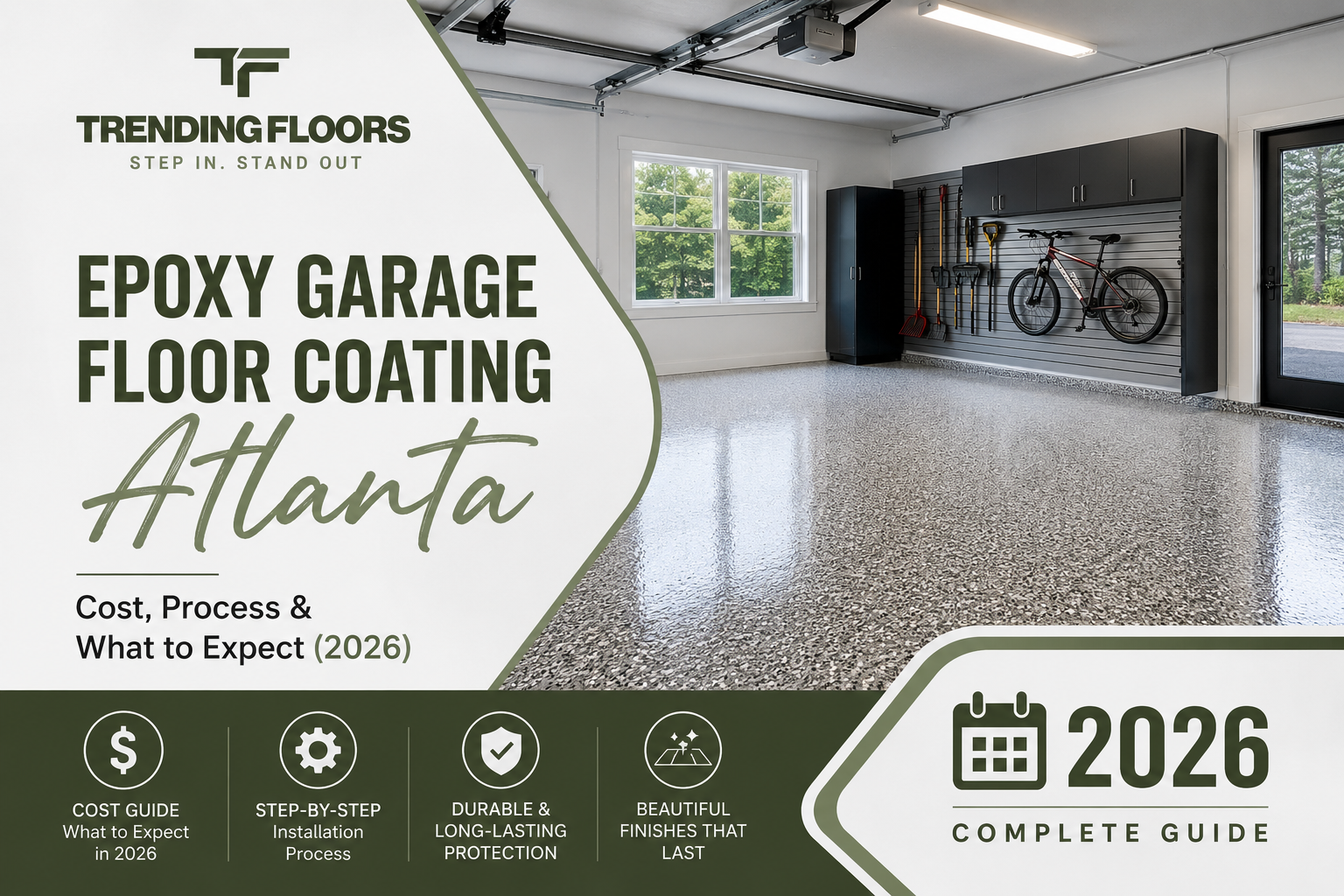
Epoxy Garage Floor Atlanta: Cost, Process & What to Expect 2026 is your complete guide to understanding installation costs, coating options, and the professional process for achieving a durable, long-lasting garage floor. Whether you’re planning a new installation or replacing an old concrete surface, this guide explains everything Atlanta homeowners need to know before making an investment.
The challenge is that not all epoxy flooring systems are created equal. Installation quality varies significantly—from DIY kits that can begin peeling within a year to professional multi-layer coating systems backed by long-term warranties. This guide explains everything you need to know about Epoxy Garage Floor Atlanta, including coating options, the complete installation process, realistic 2026 costs, and the key questions to ask before hiring a flooring contractor. Whether you’re renovating your garage or installing a new floor, understanding what to expect will help you make a confident investment.
Epoxy vs. Polyaspartic vs. Polyurea: Which Coating Is Right for Your Garage?
The terms get used interchangeably in marketing materials, but they describe meaningfully different products with different performance profiles. Understanding the distinction saves you from being upsold on something you don’t need — or undersold on something that won’t last.
Epoxy
Traditional epoxy is a two-part system — an epoxy resin mixed with a hardener — that chemically bonds to concrete and cures into an extremely hard, durable surface. True high-solids epoxy (98–100% solids content) is fundamentally different from the “epoxy paint” sold in home improvement stores, which is mostly water-based paint with a small percentage of epoxy resin added to justify the label.
Professional epoxy coatings are resistant to chemical spills, oil, abrasion, and impact. They bond deeply to properly prepared concrete, which is why surface preparation is the single most important variable in how long the coating lasts. Epoxy typically requires two to four days to complete because each layer needs adequate cure time before the next is applied.
The limitation: epoxy is UV-sensitive. Direct sunlight causes it to yellow and lose gloss over time — which is why it’s better suited to enclosed garages than open carports or outdoor surfaces.
Polyaspartic and Polyurea
Polyaspartic and polyurea coatings are newer formulations developed originally for industrial applications. They cure much faster than epoxy — many systems can be completed in a single day and driven on within 24 hours — and they are more UV-stable, meaning they hold their color and gloss better in garages with natural light exposure.
The trade-off is cost. Polyaspartic and polyurea systems typically run 20–40% more than traditional epoxy. For most Atlanta homeowners with standard enclosed garages, a professional epoxy system is entirely sufficient. The faster-cure systems earn their premium primarily in commercial settings or situations where downtime genuinely costs money.
DIY Kits: What You Need to Know
The epoxy kits at Home Depot and Lowe’s are not the same product as professional-grade coatings. They are water-based epoxy paint — thinner, lower-bond-strength, and applied without the mechanical grinding that professional installers use to prepare the concrete surface. Most DIY garage floor coatings begin to peel or chip within 12–18 months under normal vehicle use. If you’ve seen a peeling garage floor, it was almost certainly a DIY application or a contractor using sub-professional-grade materials without adequate surface prep.
The Full Epoxy Installation Process — Step by Step
Understanding the process helps you evaluate any contractor you’re considering. A professional who skips or rushes the preparation steps is guaranteeing premature failure, regardless of the quality of the coating itself.
Step 1 — Concrete Assessment and Repair
Before any coating goes down, the existing concrete needs to be evaluated. Cracks, spalling, pitting, and active moisture issues all need to be addressed first. Cracks that aren’t repaired will telegraph through the coating. Concrete with active moisture vapor emission above acceptable levels will cause the coating to delaminate — sometimes within weeks of installation.
In Atlanta specifically, moisture testing matters. Georgia’s humidity and the prevalence of slab-on-grade construction means moisture vapor transmission is a genuine concern. A contractor who doesn’t test for moisture before coating is taking a shortcut that may cost you the entire coating within a year.
Step 2 — Mechanical Surface Preparation (Grinding)
This is the step that separates professional installations from DIY and low-quality contractor work. Professional installers use diamond-tipped concrete grinders connected to industrial vacuums to open the pores of the concrete surface, remove contaminants (oil, grease, existing coatings), and create a surface profile that allows the epoxy to bond mechanically — not just sit on top.
Acid etching, which is the preparation method used in most DIY kits and some budget contractors, is significantly less effective than mechanical grinding for long-term adhesion. If a contractor mentions only acid washing for preparation, that’s a red flag worth asking about.
Step 3 — Base Coat Application
The first layer of epoxy (or primer coat in multi-system applications) is applied to the prepared concrete. In professional systems, this layer is rolled on at a precise thickness and allowed to partially cure before the next step.
Step 4 — Decorative Flake Broadcast (Optional)
While the base coat is still tacky, decorative vinyl flakes are broadcast across the surface. These serve both aesthetic and functional purposes — they add visual texture, help disguise minor surface imperfections, and provide a degree of slip resistance when sealed. Flake color options range from subtle neutral blends that mimic stone to bold solid colors. Full-broadcast flake (where the entire floor is covered) is the most popular finish in Metro Atlanta residential garages.
Step 5 — Grout Coat and Topcoat
In a multi-layer system, a clear grout coat is applied over the flakes to lock them in place and create a smooth base for the final topcoat. The topcoat — typically a polyaspartic or high-solids urethane — provides UV protection, chemical resistance, and the final gloss level. This is the layer the floor will actually be used on, and its quality determines how the floor wears over the years.
Step 6 — Cure Time
Professional epoxy systems require 24 hours before light foot traffic, 48–72 hours before returning heavy items like workbenches and storage, and at least 72 hours — ideally longer — before parking vehicles. Rushing the cure time is a common homeowner mistake that damages the finish before it has fully hardened.
What Epoxy Garage Floor Coating Costs in Atlanta (2026)
Atlanta epoxy garage floor pricing varies based on garage size, concrete condition, coating system selected, and the contractor’s experience level. Here are realistic 2026 ranges for Metro Atlanta:
- One-car garage (approximately 250 sq ft): $800–$1,500
- Two-car garage (approximately 400–500 sq ft): $1,500–$3,500
- Three-car garage (approximately 600–750 sq ft): $2,500–$5,500
- Polyaspartic/polyurea premium systems: Add 20–40% to the above ranges
- Concrete crack repairs: $100–$400 additional depending on extent
- Moisture mitigation treatment: $300–$800 additional if needed
Be skeptical of quotes significantly below these ranges. Extremely low bids typically indicate water-based coatings, inadequate surface preparation, or both — which means you’ll be paying for the project again within two to three years. The cheapest epoxy job in Atlanta is often the most expensive one over a ten-year horizon.
Trending Floors provides free, written estimates for epoxy garage floor projects across Metro Atlanta. Visit our epoxy flooring page for more details on our coating systems.
Atlanta-Specific Considerations for Epoxy Garage Floors
Georgia Humidity and Moisture Testing
Atlanta’s humid climate creates conditions where concrete slab moisture vapor transmission is higher than in drier markets. This is a significant factor for epoxy adhesion. A professional contractor should test your slab’s moisture vapor emission rate before coating. If it exceeds the coating manufacturer’s acceptable threshold, a moisture-mitigation primer needs to be applied before the epoxy system — an additional cost, but a necessary one.
Skipping this step in Atlanta is a gamble. Garages that face south or west, and those in lower-lying areas of Gwinnett, Fulton, and DeKalb counties with higher water table proximity, are particularly prone to moisture vapor issues.
Heat and UV Exposure
Georgia summers are hot. Garage temperatures in July and August regularly exceed 90°F inside enclosed spaces, and garages with windows or open doors receive direct sun exposure. Standard epoxy yellows under UV exposure over time. If your garage receives significant natural light, a UV-stable polyaspartic topcoat is worth the upgrade — it holds its color and gloss significantly longer than epoxy alone in sun-exposed conditions.
Hot Tire Pickup
This is the most common epoxy failure mode in Atlanta garages. When a vehicle has been driven and the tires are hot, they can bond slightly to an epoxy surface and lift the coating when the car pulls out. Hot tire pickup is almost exclusively a problem with lower-quality epoxy systems and inadequate topcoats. Professional-grade polyaspartic and urethane topcoats resist hot tire pickup reliably. Always ask your contractor specifically how their system handles this — any experienced local contractor should address it without prompting.
Questions to Ask Before Hiring an Epoxy Contractor in Atlanta
The epoxy garage floor market in Atlanta has a wide range of quality — from highly professional multi-step systems to budget operators using low-grade materials. These questions help you separate them quickly:
- What is the solids content of your epoxy? Professional systems are 98–100% solids. Water-based coatings are 40–50% solids and significantly less durable.
- How do you prepare the surface? The answer should include mechanical diamond grinding. Acid etching only is insufficient for long-term adhesion.
- Do you test for concrete moisture before coating? In Atlanta, the answer should be yes, every time.
- What topcoat do you use and is it UV-stable? Polyaspartic or high-solids urethane topcoats are the professional standard.
- What warranty do you provide? Reputable contractors back their work with multi-year warranties on both materials and labor.
- Can I see examples of your completed projects in Atlanta? Local references and photos of actual work matter more than national brand claims.
Frequently Asked Questions — Epoxy Garage Floors in Atlanta
How long does epoxy garage floor coating last in Atlanta?
A professionally installed, multi-layer epoxy system with a quality topcoat typically lasts 10–20 years in a residential Atlanta garage with normal use. DIY or budget coatings with inadequate surface preparation often begin failing within 1–3 years. Georgia’s heat and humidity make surface prep and topcoat quality more important here than in drier climates.
How long does epoxy installation take?
A professional two-layer epoxy system takes two to four days — one to two days for surface preparation and base coat application, and additional time for curing between layers. Polyaspartic systems can be completed in one day due to faster cure times. You should avoid parking in the garage for at least 72 hours after the final coat regardless of system type.
Is epoxy worth it for an Atlanta garage?
Yes, for most Atlanta homeowners. A professionally coated garage floor is significantly easier to clean, more resistant to oil and chemical stains, and more durable than bare concrete. It also improves the usability of the garage as a workspace and adds to the overall presentation of the home. The key is using a professional system with proper surface preparation — not a DIY kit or a budget contractor using water-based coatings.
Can epoxy be installed over existing paint or coating?
Not reliably. Existing coatings need to be ground off before a new epoxy system is applied. Coating over existing paint or epoxy almost always results in delamination because the new coating bonds to the old paint rather than to the concrete. Any contractor willing to coat over an existing finish without grinding it off first is not giving you a system that will last.
Does Atlanta’s humidity affect epoxy garage floors?
Yes. High ambient humidity during application can affect epoxy cure and adhesion. Reputable contractors monitor both concrete moisture vapor transmission and ambient conditions before and during application. Projects in Atlanta are often scheduled for cooler, lower-humidity days when possible, and moisture mitigation primers are used when slab moisture levels are elevated.
What is the difference between epoxy and polyaspartic garage floor coating?
Epoxy is a two-part resin system that provides excellent adhesion and durability but requires longer cure times and is UV-sensitive (it yellows in sunlight over time). Polyaspartic is a newer formulation that cures much faster, is UV-stable, and handles Georgia heat better — but costs 20–40% more. For enclosed Atlanta garages without significant direct sun exposure, professional epoxy with a quality urethane topcoat is often the better value. For garages with sun exposure or situations where a one-day install is required, polyaspartic is worth the premium.
How do I maintain an epoxy garage floor?
Epoxy floors are low maintenance by design. Sweep or blow out debris regularly. Mop with a neutral pH cleaner and warm water as needed — avoid acidic or abrasive cleaners that can dull the topcoat over time. Clean oil and chemical spills promptly before they have extended contact with the surface. Avoid dragging sharp or heavy metal objects directly across the floor without protection.
Get a Free Epoxy Garage Floor Estimate in Atlanta
Trending Floors installs professional epoxy garage floor coatings across Metro Atlanta — Lawrenceville, Alpharetta, Johns Creek, Sandy Springs, Roswell, and the broader Atlanta area. We assess your slab, test for moisture, and give you a written estimate with no obligation.
Book your free consultation today and let’s talk through the right coating system for your garage.
Trending Floors
465 Maltbie Street, Suite 240, Lawrenceville, GA 30046
(404) 944-2548 | estimates@trendingfloors.com
Mon–Sat 8am–6pm | Licensed & Insured | Serving all of Metro Atlanta
Have more questions? Visit our FAQ page or explore our full range of flooring installation services.