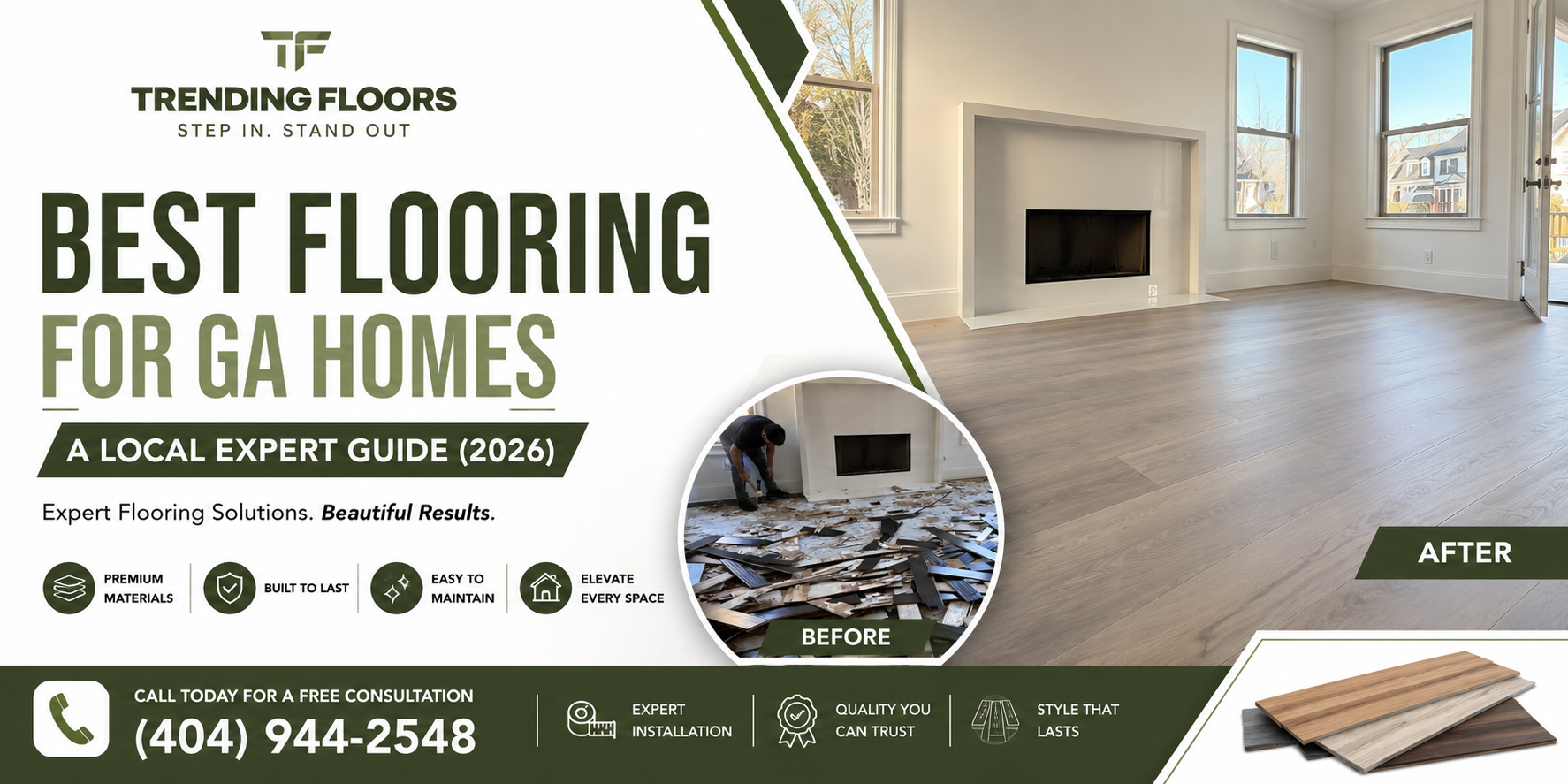
Atlanta homeowners face flooring decisions that most national guides simply don’t account for. Georgia’s humidity, the concrete slab foundations beneath the majority of Metro Atlanta homes, and the wide range of home styles across the city — from 1920s Craftsman bungalows in Grant Park to 2020s new construction in Alpharetta — all mean that what works in Denver or Phoenix may fail completely here.
This guide is written specifically for Atlanta homeowners in 2026. It covers which flooring materials actually perform in Georgia’s climate, how different Atlanta neighborhoods shape the right choice, what installation realistically costs, and what to look for when hiring a local contractor. No generic advice. Just straight answers from a team that installs floors in Atlanta homes every week.
The Two Things That Shape Every Atlanta Flooring Decision
Georgia Humidity
Atlanta sits in a humid subtropical climate zone. Summer humidity regularly exceeds 70%, afternoon thunderstorms roll through from June to September, and the moisture doesn’t stay outside. It works its way into your home — and into your floors.
Natural wood absorbs and releases moisture as the seasons change. In Atlanta, that means solid hardwood expands during humid summers and contracts during drier winters. Over time, that movement creates gaps between boards, causes cupping along the edges of planks, or in severe cases leads to buckling. The risk is manageable with the right species, finish, and installation — but it’s real, and any contractor who doesn’t mention it isn’t giving you the full picture.
Concrete Slab Foundations
Most Atlanta homes built after the 1970s sit on concrete slab foundations rather than crawl spaces. This is efficient construction for Georgia’s relatively mild winters, but it has direct consequences for flooring.
Concrete emits moisture vapor continuously — even when it feels completely dry to the touch. Solid hardwood installed directly over a concrete slab will absorb that vapor and eventually fail. This is one of the most common and most expensive flooring mistakes in the Atlanta market. The correct solutions for slab homes are LVP, engineered hardwood with proper moisture preparation, tile, or carpet — all of which handle concrete safely when installed correctly.
If you’re unsure whether your home has a slab foundation, your contractor should assess this before recommending any material.
How Atlanta’s Neighborhoods Shape the Right Flooring Choice
Atlanta is not a single market. Different parts of the city have different home ages, construction styles, and buyer expectations — and those differences matter for flooring.
Historic Intown Neighborhoods
Grant Park, Candler Park, Inman Park, Virginia-Highland, Kirkwood, and East Atlanta Village are full of homes built between 1910 and 1960. Many have original hardwood floors hiding under decades of carpet or laminate. These floors are often in better condition than homeowners expect — and refinishing them is almost always more cost-effective than replacement.
For intown historic homes, the first conversation should be about what’s already there. If the original boards are structurally sound, sanding and refinishing them restores the character that makes these homes worth buying in the first place. Where new flooring is needed, engineered hardwood in period-appropriate species — oak, hickory, walnut — tends to match the architectural character better than vinyl.
Midtown, Buckhead, and High-Rise Condos
Condos and high-rise units present a different set of constraints. Many buildings regulate sound transmission between floors through HOA rules, requiring a minimum underlayment rating. Floating floor installations are typically preferred over glue-down or nail-down methods in these settings.
LVP with a quality acoustic underlayment is the most practical solution for most Atlanta condo projects — waterproof, compatible with concrete subfloors, and better for sound absorption than tile or hardwood when paired with the right pad. Check your building’s HOA guidelines before selecting materials.
North Atlanta Suburbs
Alpharetta, Johns Creek, Sandy Springs, Roswell, and Dunwoody are dominated by newer construction — most on slab foundations, with open floor plans and larger square footage. LVP performs exceptionally well in these homes. Wide-plank formats (7″–9″ widths) suit the open layouts, and the fully waterproof core handles both the slab foundation and the active family life common in these communities.
For the higher-end market in Alpharetta and Johns Creek, engineered hardwood remains popular because Atlanta buyers in the $500K+ range often expect real wood — and it delivers the resale value that LVP, for all its practical advantages, doesn’t quite match at the top of the market.
Gwinnett County and East Metro
Lawrenceville, Norcross, Duluth, Lilburn, and the broader Gwinnett corridor are some of Metro Atlanta’s most active flooring markets. Housing stock ranges from 1980s subdivisions to brand-new builds, and the predominant preference is for durable, practical flooring that holds up in family homes without requiring constant maintenance.
LVP is by far the most common choice here — delivering hardwood aesthetics at a price point that makes sense for the larger square footages common in Gwinnett homes. Tile is the standard for kitchens and bathrooms. Carpet continues to hold its ground in bedrooms and upstairs areas.
The Best Flooring Materials for Atlanta Homes
Luxury Vinyl Plank (LVP)
LVP is the most practical choice for the majority of Atlanta homes. It’s 100% waterproof through the core — not just a surface coating — which means it handles both the concrete slab moisture issue and the spills, pet accidents, and humidity fluctuations that come with Georgia living. It installs cleanly over concrete without the moisture barrier concerns that engineered hardwood requires, and it won’t expand or contract with seasonal humidity changes.
In 2026, the dominant trend in Atlanta is wide-plank LVP in warm oak tones with matte finishes — a clear move away from the cool gray flooring that defined the last decade. These formats suit the open floor plans of North Atlanta suburban homes and photograph well for real estate listings, which matters in a market where homes are frequently listed and sold.
For households that want the next level of performance — quieter underfoot, denser core, more impact resistance — hybrid rigid core is worth considering. It builds on the LVP platform with a denser construction that handles heavy furniture, energetic pets, and high-traffic zones more effectively.
Engineered Hardwood
Engineered hardwood is built with a real wood veneer bonded over a layered plywood or composite core. That construction makes it significantly more stable than solid hardwood in humidity — which is why it has become the standard wood flooring recommendation for Atlanta homes, particularly those on slab foundations.
The real advantage of engineered hardwood over LVP is resale value and authenticity. Atlanta buyers — especially in the $400K+ market — recognize and value real wood. Engineered hardwood can also be refinished, which extends its life by decades and allows you to update the look without replacing the floor.
The trade-off: it costs more than LVP, requires more careful subfloor preparation (including moisture testing over concrete), and is water-resistant rather than fully waterproof. It’s the right choice for households that want real wood and are willing to manage it correctly.
Tile
Porcelain and ceramic tile are the default for Atlanta kitchens, bathrooms, mudrooms, and laundry rooms — and with good reason. Tile is genuinely waterproof, scratch-proof, and never absorbs odors. It’s the one material that requires no real compromise in wet zones.
The 2026 trend in Atlanta is large-format porcelain (24″x24″ and above) with minimal grout lines — a cleaner, more contemporary look that also happens to be easier to maintain than smaller tiles with more grout. Warm-toned stone-look porcelain is particularly popular in kitchens across North Atlanta.
Carpet
Carpet’s role in Atlanta homes has narrowed but not disappeared. Bedrooms, bonus rooms, upstairs hallways, and media rooms are where carpet still makes genuine sense — providing warmth, noise absorption, and a softer surface that hard floors simply can’t replicate. The key is using carpet where it belongs rather than throughout the main living areas, where the maintenance burden in an active household becomes impractical.
Solution-dyed nylon is the most durable fiber for Atlanta families with kids or pets. Polyester is a cost-effective alternative for lower-traffic bedrooms.
What Flooring Installation Costs in Atlanta in 2026
Atlanta flooring costs depend on the material, the square footage, the condition of your existing subfloor, and whether old flooring needs to be removed first. Here are realistic 2026 ranges for Metro Atlanta projects:
- LVP installed: $4–$8 per square foot
- Engineered hardwood installed: $7–$14 per square foot
- Tile installed: $8–$15 per square foot
- Carpet installed: $3–$7 per square foot
- Hardwood refinishing: $3–$6 per square foot
A full main-floor project covering 1,000–1,500 square feet typically runs between $5,000 and $15,000 depending on the material chosen. Subfloor leveling, moisture barrier installation, and removal of existing flooring are line items to factor in beyond the base per-square-foot cost.
The most reliable way to get an accurate number for your specific home is a free in-home estimate — which accounts for your actual square footage, subfloor condition, and the material you’re considering. Trending Floors provides written, itemized estimates at no charge across Metro Atlanta.
What to Look for in an Atlanta Flooring Contractor
Licensing and Insurance
Verify that any contractor is licensed in Georgia and carries both general liability and workers’ compensation insurance. An unlicensed or uninsured contractor creates significant financial exposure if something goes wrong during or after the project.
Local Experience
A contractor who works in Atlanta homes regularly understands slab foundations, Georgia’s humidity, and the specific challenges of intown historic homes versus North Atlanta new construction. Ask directly how long they’ve worked in the Metro Atlanta market and whether they’ve installed your preferred material in homes similar to yours.
Subfloor Assessment
No material recommendation should be made without assessing your subfloor first. Moisture testing over concrete slabs, checking for level and stability, and identifying existing damage are non-negotiable steps before any installation. A contractor who skips this step is setting you up for problems down the road.
Written Estimate
Reputable contractors provide written, itemized estimates before work begins — covering materials, labor, subfloor prep, and removal of existing flooring. Verbal quotes or vague per-foot numbers without line items are a warning sign.
Frequently Asked Questions — Flooring in Atlanta GA
What is the best flooring for Atlanta homes?
For most Atlanta homes — particularly those on concrete slab foundations — luxury vinyl plank (LVP) is the most practical choice. It’s 100% waterproof, handles Georgia’s humidity without warping, and installs safely over concrete. Engineered hardwood is the best choice for homeowners who want real wood and are prioritizing resale value. Tile is the right call for kitchens, bathrooms, and wet zones.
Can you install hardwood floors over a concrete slab in Atlanta?
Solid hardwood should not be installed directly over a concrete slab in Atlanta. Concrete emits moisture vapor that will damage solid wood over time — a significant risk in Georgia’s humid climate. Engineered hardwood can be installed over properly prepared concrete with moisture testing and a vapor barrier in place. LVP is the most reliable and common choice for Atlanta slab homes.
How much does flooring installation cost in Atlanta in 2026?
Most Atlanta flooring projects run between $4 and $15 per square foot installed depending on material. A full main-floor project covering 1,000–1,500 square feet typically costs between $5,000 and $15,000. Subfloor repairs and old floor removal are additional costs that vary by project. A free in-home estimate gives you the most accurate number for your specific home.
Does Atlanta’s humidity affect flooring performance?
Yes, significantly. Atlanta’s humid subtropical climate — particularly the wet summer months — causes solid hardwood to expand and contract as moisture levels shift. Over time this leads to gaps, cupping, or buckling. LVP and engineered hardwood are far more stable in Atlanta’s humidity than solid hardwood, which is why most experienced local contractors recommend them for the majority of Atlanta homes.
How long does flooring installation take in Atlanta?
Most residential projects take one to three days. A single room can often be completed in one day. Whole-home projects covering 1,500+ square feet typically take two to three days. Projects that require subfloor leveling or custom tile work may take longer. Your contractor should provide a clear timeline before work begins.
What flooring is trending in Atlanta homes in 2026?
Wide-plank LVP and engineered hardwood in warm oak tones with matte finishes are the dominant choices across Metro Atlanta in 2026. The cool gray flooring trend of the past decade has largely faded in favor of warmer, more natural wood looks. Large-format porcelain tile with minimal grout lines is leading in kitchens and bathrooms. Carpet continues to hold its place in bedrooms and bonus rooms.
Ready to Find the Right Floor for Your Atlanta Home?
Trending Floors is a licensed, insured flooring contractor serving all of Metro Atlanta — from Lawrenceville and Gwinnett County to Buckhead, Sandy Springs, Alpharetta, and beyond. We bring samples to your home, assess your subfloor, and provide a written estimate with no obligation.
Book your free consultation today and get straightforward advice from a local team that knows Atlanta homes.
Trending Floors
465 Maltbie Street, Suite 240, Lawrenceville, GA 30046
(404) 944-2548 | estimates@trendingfloors.com
Mon–Sat 8am–6pm
Explore our full range of LVP flooring and hardwood refinishing services, or visit our FAQ page for more answers.