
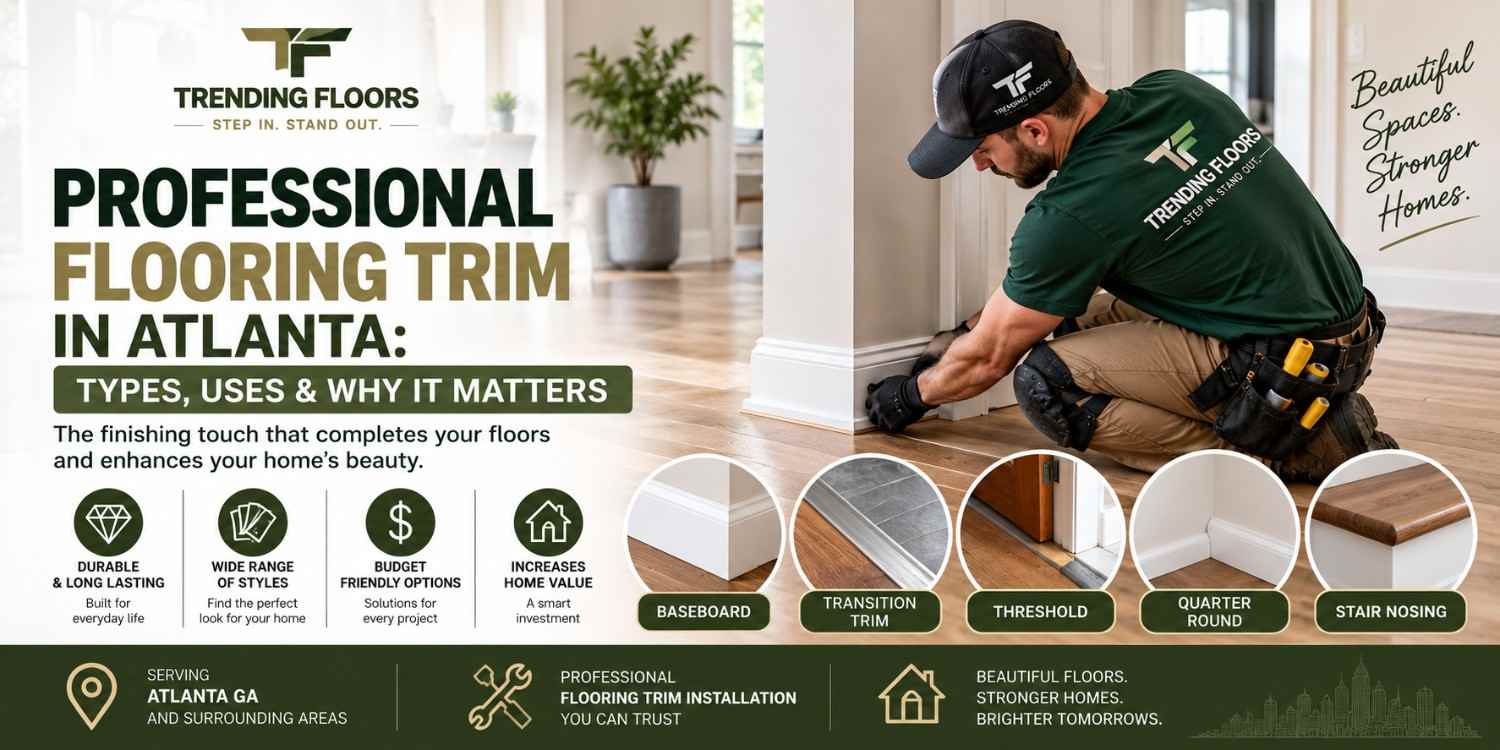
Professional flooring trim is one of the most overlooked parts of any flooring project – and one of the most important. The right trim pieces are what separate a floor that looks finished and polished from one that looks rushed or incomplete. Whether you’re having LVP flooring installed in a Gwinnett County home or getting new hardwood flooring laid in an intown Atlanta property, the trim and transition pieces your installer uses will determine how every room edge, doorway, and floor change looks for years to come.
At Trending Floors, we supply and install every type of professional flooring trim across Metro Atlanta – matched to your specific flooring material and finished to look intentional, not like an afterthought. This guide explains each trim type, where it belongs, and why getting it right matters.
What Is Professional Flooring Trim?
Flooring trim – also called molding, transitions, or finishing pieces – refers to the strips and profiles installed along the edges and transitions of a floor installation. Their job is both functional and aesthetic: they cover expansion gaps, protect floor edges from chipping, and create smooth visual transitions between different flooring surfaces or between flooring and walls.
Without proper professional flooring trim, floors look unfinished at their edges. More importantly, bare expansion gaps can collect debris and moisture, and exposed floor edges on LVP or hardwood can chip or lift over time. The right trim pieces protect your flooring investment at its most vulnerable points.
The Main Types of Professional Flooring Trim and Where Each Is Used
1. T-Molding
T-molding is used wherever two floors of the same height meet – most commonly in doorways between two rooms, or between two different flooring materials at the same level. The T-shape sits on top of both floors and bridges the gap between them, creating a clean visual break while allowing each floor to expand and contract independently with temperature changes.
In Atlanta’s climate – with significant humidity swings between summer and winter – hardwood and LVP both expand and contract seasonally. T-molding in doorways is not optional; it protects both floors from buckling caused by trapped expansion.
2. Reducer Strips
A reducer is used when two floors meet at different heights – typically when transitioning from a thicker flooring surface (like 3/4″ solid hardwood) to a thinner one (like LVP or carpet). The reducer slopes down from the higher floor to the lower one, creating a smooth ramp that eliminates trip hazards and looks intentional rather than mismatched.
Reducers are one of the most common professional flooring trim pieces we install across Metro Atlanta, particularly in renovation projects where LVP is added to rooms that adjoin existing hardwood or tile at a different thickness.
3. Threshold Strips
Thresholds are used at exterior doorways and at transitions between flooring and tile – particularly in bathrooms, laundry rooms, and kitchens. A threshold is designed to handle the transition from interior flooring to an exterior surface or wet-area surface, with a profile that accommodates larger height differences or seals against drafts.
Marble and stone thresholds are common in higher-end Atlanta homes – used at bathroom doorways between tile and hardwood or LVP in a hallway. They provide a premium finished look and are more water-resistant than wood or vinyl thresholds.
4. Quarter Round Molding
Quarter round is the thin curved molding installed along the base of walls where the flooring meets the baseboard. It covers the expansion gap required at the wall perimeter for hardwood and LVP installations. Without quarter round, the gap between the floor and baseboard is visible – even a 1/4″ gap looks unfinished in a clean room.
On LVP installations, quarter round is typically PVC-based or vinyl for moisture resistance. On hardwood it’s generally a matching wood profile that can be stained or painted to match the baseboard.
5. Stair Nose (Stair Tread Caps)
Stair nose trim covers the exposed front edge of each stair tread when flooring is installed on stairs. It protects the most vulnerable part of a stair – the leading edge – from chipping and wear, and it creates the rounded, finished profile that makes stair treads look intentional rather than abruptly cut.
For LVP stair installations, stair nose is critical – exposed LVP edges on stair treads will chip quickly under normal foot traffic without the nose cap protecting them. For hardwood stairs, a matching wood stair nose creates a clean, cohesive look across the entire staircase.
6. End Cap
End caps are used at the termination point of a floor – such as at a sliding door track, a fireplace hearth, or anywhere a floor ends without a wall to run baseboard against. They create a finished edge rather than an exposed, visible cut. Floor vent covers are a related trim category – the decorative grilles that sit in the floor over HVAC vents, finished flush with the new floor surface.
Why Matching Trim to Your Flooring Material Matters
The biggest mistake homeowners see after a rushed flooring installation is mismatched or generic trim – a golden oak T-molding on a cool gray LVP floor, or bright white quarter round on a dark-stained hardwood installation. The floor itself may be excellent, but mismatched professional flooring trim draws the eye to every doorway and wall edge.
At Trending Floors, we use manufacturer-matched trim wherever available for LVP and engineered hardwood installations, and we stain or paint trim pieces on site for solid hardwood projects where custom color matching produces the cleanest result.
Professional Flooring Trim for LVP Installations in Atlanta
LVP is currently the most-installed flooring type across Metro Atlanta – and it comes with its own specific trim requirements. Because LVP is a floating floor, it requires larger expansion gaps at walls and doorways than nail-down hardwood. That means the professional flooring trim pieces covering those gaps need to be properly sized.
A common issue we see on DIY or budget LVP installations is trim that’s too narrow – installed over expansion gaps that are too small, which means the floor has nowhere to go when it expands in Atlanta’s summer humidity. When the floor buckles, the trim pops up with it. Proper professional flooring trim for LVP leaves the right gap and covers it cleanly without restricting movement.
The standard LVP trim package for a whole-home installation includes: T-molding at all interior doorways, reducer strips where LVP meets tile, quarter round at all walls, and threshold strips at exterior doors. Stair nose is added for any stairs being covered in LVP.
Professional Flooring Trim for Hardwood Installations
Hardwood flooring trim is typically wood-based and either pre-finished (factory-stained to match the planks) or site-finished (stained after installation to achieve an exact match). For hardwood floor refinishing projects, it’s worth inspecting the existing trim at the same time – if the finish on the existing quarter round has dulled or the color no longer matches a refinished floor, replacing the trim alongside the refinish ensures a cohesive final look.
What to Expect During Professional Trim Installation
Trim installation is the final step of any Lawrenceville and Metro Atlanta flooring project. Our crew installs professional flooring trim in a defined sequence:
- Baseboard and quarter round first – perimeter trim is installed before doorway transitions so all edges terminate cleanly
- Doorway transitions second – T-moldings and reducers are fitted after perimeter trim is in place
- Thresholds and end caps last – installed after all interior trim is complete
- Stair nose and stair trim – secured per stair with construction adhesive and finish nails for maximum hold
The entire trim installation for a typical Atlanta home of 1,200–2,000 square feet adds one to two hours to project completion time. According to the National Wood Flooring Association, proper trim installation is essential to the long-term performance of any hardwood or engineered floor installation.
How Much Does Professional Flooring Trim Cost in Atlanta?
- Quarter round: $1.50–$3.00 per linear foot installed
- T-molding: $15–$35 per piece installed
- Reducer strip: $15–$30 per piece installed
- Threshold: $20–$50 per piece installed (marble/stone higher)
- Stair nose: $20–$45 per tread installed
Most Atlanta whole-home flooring installations include professional flooring trim in the overall project quote. At Trending Floors, we provide written estimates that itemize flooring, labor, and trim separately – so you see exactly what each component costs before work begins.
Ready to Get Your Floors Finished Right?
Professional flooring trim is the detail that makes a flooring installation look finished instead of rushed. If you’re planning a new floor installation or replacing worn or mismatched trim on existing floors, Trending Floors provides free in-home consultations across Metro Atlanta – Lawrenceville, Alpharetta, Johns Creek, Sandy Springs, Roswell, and the broader Atlanta area.
Book your free consultation and we’ll assess your project, recommend the right trim package, and provide a written estimate with no obligation.
📞 (404) 944-2548 | estimates@trendingfloors.com | Mon–Sat 8am–6pm
Frequently Asked Questions – Professional Flooring Trim Atlanta
What is professional flooring trim and why do I need it?
Professional flooring trim refers to the molding and transition pieces installed at the edges and transitions of a floor – quarter round along walls, T-molding in doorways, reducers where floors change height, and thresholds at exterior doors. Trim covers expansion gaps that every floating floor requires, protects exposed floor edges from chipping, and gives the installation a finished, professional appearance. Without proper trim, even a high-quality floor looks unfinished.
What is the difference between T-molding and a reducer strip?
T-molding is used when two floors meet at the same height – the T-shape bridges the gap between them at the same level. A reducer strip is used when two floors meet at different heights – it slopes from the higher floor down to the lower one to eliminate a trip hazard. In Atlanta homes where LVP meets existing hardwood or tile at a different thickness, a reducer is usually the correct professional flooring trim choice.
Does LVP flooring need the same trim as hardwood?
LVP requires the same types of trim as hardwood – T-molding, reducers, quarter round, thresholds, and stair nose – but the trim pieces are typically vinyl or PVC-based and manufacturer-matched to the specific LVP product. LVP is a floating floor with larger seasonal movement than nail-down hardwood, so expansion gaps covered by professional flooring trim need to be sized appropriately.
Can I replace just the trim without replacing my floors?
Yes. Replacing worn, damaged, or mismatched trim is a standalone service that doesn’t require removing or replacing the existing flooring. This is particularly common after a floor refinishing project – when the floor is refinished to a new color, the existing trim may no longer match. Trending Floors provides trim-only services across Metro Atlanta.
What type of trim is used at the bottom of walls with LVP?
Quarter round molding is the standard professional flooring trim used along the base of walls where LVP meets the baseboard. It covers the 1/4″–3/8″ expansion gap required at every wall perimeter for a floating LVP installation. Quarter round for LVP is typically PVC or composite for moisture resistance, available in colors matched to the LVP product.
How long does trim installation take for a typical Atlanta home?
For a typical Metro Atlanta home of 1,200–2,000 square feet with standard doorway transitions, wall perimeter trim, and exterior thresholds, professional flooring trim installation adds one to two hours to the overall flooring project. Stair installations require approximately 30–45 minutes per flight additional.
Does Trending Floors install flooring trim across all of Metro Atlanta?
Yes. Trending Floors installs professional flooring trim as part of every flooring installation and as a standalone service across all of Metro Atlanta – Lawrenceville, Duluth, Norcross, Alpharetta, Johns Creek, Sandy Springs, Roswell, and the broader Atlanta area. All trim is included in your written project estimate before work begins. Call (404) 944-2548 or book a free consultation online.