
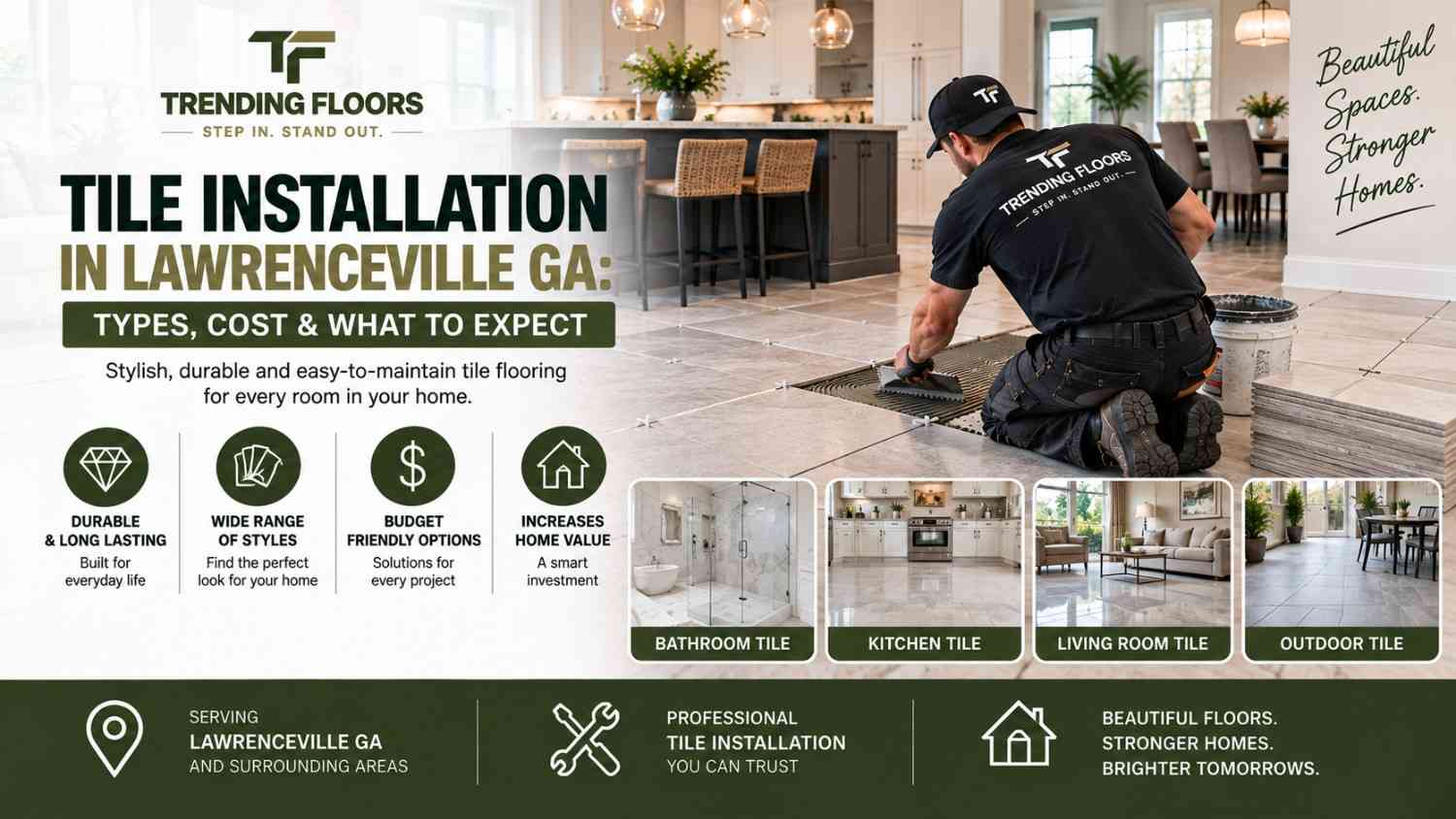
Tile flooring in Lawrenceville and across Gwinnett County has evolved significantly in the past five years. The 12×12 ceramic tile that defined most of Gwinnett County’s 1990s and 2000s kitchen and bathroom installations has given way to large-format rectified porcelain – 24×24 and larger, minimal grout lines, and a clean contemporary aesthetic that transforms kitchens and bathrooms in ways that smaller tile formats simply cannot achieve. If you are planning tile installation in a Lawrenceville home in 2026, this guide gives you everything you need to make the right decisions before the first tile goes down.
Why Tile Is the Right Choice for Specific Rooms in Lawrenceville Homes
Lawrenceville’s housing stock – predominantly concrete slab construction from the 1980s through 2010s – is well-suited to tile installation. Concrete slabs are an ideal substrate for tile when properly prepared and leveled. Georgia’s humidity makes tile’s inherently waterproof surface particularly practical in kitchens and bathrooms, and the active family households common across Gwinnett County’s communities benefit from tile’s near-zero maintenance requirements in high-traffic wet zones.
Kitchens – Large Format Porcelain
The kitchen is where tile investment delivers its strongest return in Lawrenceville homes. Large-format rectified porcelain in 24×24 or larger formats creates a seamless, contemporary aesthetic that photographs exceptionally well for MLS listings and satisfies buyer expectations in Gwinnett County’s active resale market. The minimal grout lines of large-format tile – typically 1/8 inch versus the 3/8 inch lines standard with smaller tiles – dramatically reduce the grout maintenance that made smaller kitchen tile formats frustrating over time. In open-plan Lawrenceville homes where the kitchen floor transitions visually to the living area, large-format porcelain with minimal grout lines creates a cohesive flow that smaller tile cannot achieve.
Bathrooms – Master and Secondary
Bathrooms are tile’s strongest application in any Lawrenceville home. The moisture environment of a working bathroom – daily shower steam, water splashing from the vanity, wet feet on the floor – makes tile the only flooring that handles these conditions without any long-term concern. In Lawrenceville’s master bathrooms, large-format porcelain in warm stone and travertine looks – 24×24 or 12×24 formats – is the 2026 specification that satisfies buyers and complements the warm wood tones now dominating Gwinnett County’s renovation market. For secondary bathrooms, 12×24 or 12×12 porcelain remains a practical and attractive specification at more accessible price points.
Mudrooms and Laundry Rooms
Lawrenceville’s active family homes – where outdoor activity, Georgia red clay, and wet gear are everyday realities – need a mudroom flooring that cleans instantly and never stains. Large-format porcelain with epoxy grout (rather than standard cement grout) is the correct specification for Lawrenceville mudrooms. Epoxy grout seals the joints between tiles completely, eliminating the grout-line staining from Georgia red clay that standard cement grout develops over time regardless of sealing.
Entryways and Foyers
Foyer tile sets the visual tone for the entire home – and in Lawrenceville’s resale market, a well-chosen foyer tile makes a strong first impression at listing time. Large-format porcelain in a pattern or herringbone layout, or a premium natural stone look in a large neutral format, is the specification that most effectively establishes quality at entry.
Porcelain vs Ceramic Tile – Which Is Right for Lawrenceville Homes
The porcelain versus ceramic decision is the most common tile specification question Lawrenceville homeowners ask – and one where the honest answer is more nuanced than the marketing materials suggest.
Porcelain Tile – The Professional Recommendation for Most Applications
Porcelain is fired at higher temperatures than ceramic, producing a denser, less porous tile that is harder, more water-resistant, and more durable under heavy use. The water absorption rate of porcelain tile is less than 0.5% – essentially impervious to moisture penetration. This density makes porcelain appropriate for any residential application including high-moisture environments, outdoor use, and commercial spaces.
According to the Tile Council of North America, porcelain tile is the recommended specification for any application where moisture resistance, durability, or heavy foot traffic are primary considerations – which describes most Lawrenceville kitchen, bathroom, and mudroom applications accurately.
Trending Floors carries and installs a full range of porcelain tile flooring across Lawrenceville and Gwinnett County – including large-format rectified porcelain, through-body porcelain, and premium stone-look porcelain in the formats and finishes most requested in Gwinnett County’s 2026 market.
Ceramic Tile – Appropriate for Lower-Demand Applications
Ceramic tile is fired at lower temperatures, producing a softer, more porous tile with a water absorption rate typically between 3% and 7%. It is less expensive than porcelain and appropriate for residential wall tile, backsplash applications, and lower-traffic floor areas where heavy use and moisture are not primary concerns. In Lawrenceville’s active family households, ceramic tile on kitchen and bathroom floors is a cost-effective choice that performs well when properly sealed and maintained – but it will not match porcelain’s longevity under the same conditions.
Large Format Rectified Porcelain – The 2026 Standard
Rectified porcelain is cut to precise dimensions after firing – producing tiles with perfectly straight edges that allow installation with minimal grout joints. The combination of large format (24×24 or larger) and rectified edges creates the clean, contemporary aesthetic that now dominates Gwinnett County’s renovation market. It is the specification that requires the most precise subfloor preparation – large format tiles reveal subfloor unevenness that smaller tiles would hide – and the most skilled installation to achieve lippage-free results.
The Tile Installation Process – What Professional Installation Involves
Understanding the professional tile installation process helps Lawrenceville homeowners evaluate any contractor they consider and know what to expect before, during, and after a tile project.
Step 1 – Subfloor Assessment and Preparation
Professional tile installation begins with thorough subfloor assessment. For Lawrenceville’s concrete slab homes, the slab surface must be within 1/8 inch in 10 feet of flatness – the TCNA standard for large-format tile installation. High spots are ground down with an angle grinder. Low spots are filled with floor-leveling compound and allowed to cure – typically 24 hours – before tile installation begins. Cracks in the concrete are filled with flexible polyurethane filler to prevent tile cracking above them as the slab moves seasonally.
Step 2 – Layout Planning
Before any adhesive goes down, the tile layout is planned across the full room. The center of the room is identified and layout lines established to ensure tiles are centered and cuts at walls are symmetrical on opposite sides. For large-format tile, this planning phase determines the visual outcome of the finished installation – a poorly planned layout produces awkward cut pieces at doorways and walls that look unfinished regardless of installation quality.
Step 3 – Adhesive and Tile Setting
Large-format porcelain requires a high-performance large-format tile mortar – standard thin-set is not appropriate for tiles larger than 15×15 inches. The mortar is applied to the subfloor using a notched trowel sized to the tile format, and back-buttering (applying mortar to the tile back as well) is required for large-format tiles to achieve the full-coverage bond that prevents hollow spots beneath the tile. Tiles are set with spacers to maintain consistent joint width and leveled with a tile leveling clip system to prevent lippage between adjacent tiles.
Step 4 – Grout Selection and Application
After the adhesive has cured – typically 24 hours – grout is applied to the joints. For standard residential applications, unsanded grout for joints under 1/8 inch and sanded grout for wider joints are the standard specifications. For Lawrenceville mudrooms and high-traffic entryways, epoxy grout – which bonds chemically rather than cement-based – provides stain resistance, chemical resistance, and waterproofing at the joint that no standard grout can match. Epoxy grout costs more and requires more precise installation technique, but eliminates the ongoing grout maintenance that makes standard cement grout frustrating in high-use areas.
Step 5 – Grout Sealing and Cure
Standard cement grout requires sealing after curing to reduce staining susceptibility. The TCNA recommends allowing grout to cure for a minimum of 72 hours before sealing, and most sealers require 24 hours of drying time before the floor is returned to service. Light foot traffic is appropriate 24 hours after grouting – wet mopping and heavy use after 72 hours and sealer application.
Common Tile Installation Mistakes in Lawrenceville Homes
Tile installation mistakes are more common – and more costly to correct – than mistakes with any other flooring type. These are the errors Trending Floors most frequently encounters when assessing failed or failing tile installations in Gwinnett County homes.
- Inadequate subfloor leveling – large-format tile requires a flatter substrate than smaller tile. Failing to achieve the 1/8 inch in 10 feet flatness standard produces lippage – tile edges that sit higher than adjacent tiles – that is visible, uncomfortable underfoot, and virtually impossible to correct after installation without full removal.
- Insufficient mortar coverage – hollow spots beneath tiles caused by inadequate mortar coverage crack tiles under concentrated loads and allow moisture to penetrate beneath the tile layer. The TCNA requires minimum 80% mortar coverage in dry areas and 95% coverage in wet areas.
- Standard thin-set under large-format tile – using standard thin-set rather than large-format mortar under 24×24 and larger tiles produces inadequate coverage and bonding. Large-format mortar is specifically formulated to maintain workability long enough for the precise positioning large tiles require.
- Cement grout in high-traffic areas – standard cement grout in Lawrenceville mudrooms, entryways, and laundry rooms stains from Georgia red clay within months of installation. Epoxy grout in these applications is worth the additional cost.
- No expansion joints – tile installations require movement joints at all changes in plane, at perimeter walls, and at maximum intervals across large floor areas. Without proper expansion joints, the thermal movement of Georgia’s climate will crack grout and eventually crack tile in large installations.
Tile vs LVP – The Lawrenceville Kitchen and Bathroom Decision
The most common flooring decision Lawrenceville homeowners face in kitchens and bathrooms is tile versus LVP flooring – and both are legitimate choices with different strengths.
Tile wins on: absolute waterproofing at the surface level, durability under heavy use and cleaning cycles, long-term maintenance costs (tile properly installed with sealed grout requires virtually no maintenance over 20+ years), and premium aesthetic in master bathrooms where large-format porcelain sets a quality standard that LVP cannot match.
LVP wins on: installation time (tile takes 3–5 days versus 1–2 for LVP), upfront cost (tile installation is more expensive per square foot than LVP), warmth and comfort underfoot (tile is cold and hard, LVP is warmer and more forgiving), and seamless transition from adjacent rooms (LVP in the same format as the main floor creates visual continuity that tile breaks).
The honest recommendation for Lawrenceville homeowners: tile in bathrooms and mudrooms where moisture is constant and a premium aesthetic matters. LVP in kitchens where the priority is seamless transition from main-floor LVP and fast, cost-effective installation. Both materials are excellent choices in the right application.
Tile Installation Cost in Lawrenceville GA
Lawrenceville tile installation costs are broadly consistent with Gwinnett County market rates. Realistic 2026 ranges:
- Standard ceramic tile installed (12×12): $6–$10 per sq ft
- Porcelain tile installed (12×24): $8–$13 per sq ft
- Large-format rectified porcelain installed (24×24+): $10–$16 per sq ft
- Premium natural stone look porcelain: $12–$20 per sq ft
- Epoxy grout upgrade: $2–$4 per sq ft additional
- Subfloor leveling if required: $2–$5 per sq ft additional
- Old tile removal and disposal: $2–$4 per sq ft additional
- Heated floor mat under tile: $6–$12 per sq ft additional
A typical Lawrenceville kitchen tile installation (150–250 sq ft, large-format porcelain) runs $2,000–$5,000. A master bathroom tile project (80–120 sq ft) runs $1,500–$3,500. Whole-home tile in kitchens and bathrooms in a typical Gwinnett County home typically runs $6,000–$15,000 depending on total area and material specification.
Tile Installation Across Lawrenceville and Gwinnett County
Trending Floors provides professional tile installation across all of Lawrenceville and Gwinnett County – from kitchen and bathroom tile in established neighborhoods near downtown Lawrenceville to large-format porcelain installations in newer construction along Sugarloaf Parkway, Buford Drive, and the communities surrounding Lawrenceville’s growing medical and technology corridor.
We are based in Lawrenceville – 465 Maltbie Street, Suite 240 – and complete tile installation projects throughout Gwinnett County including Duluth, Norcross, Lilburn, Snellville, Buford, and Dacula. Our professional flooring installation services include complete tile installation with subfloor assessment, layout planning, large-format mortar application, leveling clip systems, and epoxy grout upgrades where appropriate.
Frequently Asked Questions – Tile Installation Lawrenceville GA
For additional questions about tile and flooring across Gwinnett County, visit our Atlanta flooring FAQ.
What is the most popular tile for Lawrenceville GA kitchens and bathrooms in 2026?
Large-format rectified porcelain in 24×24 or 12×24 formats in warm stone and travertine looks with minimal grout lines is the dominant tile specification in Lawrenceville kitchens and bathrooms in 2026. Matte and satin finishes are replacing the polished porcelain that dominated the previous decade. Warm neutral tones – cream, warm gray, sand, and beige – complement the warm wood LVP and engineered hardwood now standard on Gwinnett County main floors and photograph well for real estate listings.
How much does tile installation cost in Lawrenceville GA?
Tile installation in Lawrenceville runs $6–$10 per square foot for standard ceramic, $8–$13 for 12×24 porcelain, and $10–$16 for large-format rectified porcelain – all installed. A kitchen tile project (150–250 sq ft) runs $2,000–$5,000. A master bathroom (80–120 sq ft) runs $1,500–$3,500. Subfloor leveling, old tile removal, and epoxy grout upgrades are additional costs that vary by project. Trending Floors provides free written estimates for all tile projects across Lawrenceville and Gwinnett County.
How long does tile installation take in Lawrenceville?
A standard Lawrenceville kitchen tile project (150–250 sq ft) takes three to four days – one to two days for tile setting, one day for grouting after adhesive cure, and time for sealing. A master bathroom runs two to three days. Large-scale projects covering multiple rooms run five to eight days. These timelines cannot be significantly shortened – the adhesive and grout cure chemistry requires specific time periods regardless of how quickly tile is placed. Plan for the kitchen or bathroom to be unavailable during installation and the 24 hours following grouting.
What is the difference between porcelain and ceramic tile for Lawrenceville homes?
Porcelain is fired at higher temperatures, producing a denser tile with less than 0.5% water absorption – virtually impervious to moisture. Ceramic tile is less dense, with water absorption of 3–7%, making it more appropriate for walls, backsplashes, and lower-traffic floor areas. For Lawrenceville kitchen floors, bathroom floors, and mudrooms where moisture and heavy use are daily realities, porcelain is the professional recommendation. The cost difference is typically $2–$4 per square foot installed – worth the investment for long-term performance in demanding applications.
Do I need large-format tile or can I use smaller tiles in my Lawrenceville kitchen?
Both work – the decision comes down to aesthetic goals and budget. Large-format tile (24×24 and above) creates a contemporary, seamless aesthetic with fewer grout lines that most Lawrenceville homeowners prefer in 2026. It also requires a flatter subfloor and more skilled installation to avoid lippage. Smaller formats (12×24 and 12×12) are easier to install on imperfect subfloors and cost less both in materials and labor – making them a practical choice when budget is the primary consideration or where the subfloor has unevenness that would be challenging to level for large-format tile.
Should I use epoxy grout or standard grout in my Lawrenceville kitchen?
For Lawrenceville kitchens and mudrooms – yes, epoxy grout is worth the additional cost. Standard cement grout stains from cooking oils, Georgia red clay, and repeated cleaning cycles within months of installation in these high-use areas. Epoxy grout bonds chemically and is impervious to staining, chemical exposure, and moisture penetration at the joint – eliminating the ongoing grout maintenance that makes standard grout frustrating in kitchen and mudroom applications. For master bathrooms with lighter use and regular cleaning, standard premium grout with professional sealing is adequate.
Does Trending Floors install tile in Lawrenceville GA?
Yes. Trending Floors installs porcelain and ceramic tile throughout Lawrenceville and all of Gwinnett County – kitchens, bathrooms, mudrooms, entryways, and commercial spaces. We are based in Lawrenceville at 465 Maltbie Street, Suite 240, and complete tile projects across all Lawrenceville zip codes (30043, 30044, 30045, 30046) as well as Duluth, Norcross, Lilburn, Snellville, and Buford. We provide subfloor assessment, layout planning, large-format mortar installation, leveling systems, and epoxy grout upgrades. Call (404) 944-2548 or book online for a free in-home tile consultation.
Ready for New Tile in Your Lawrenceville Home?
Trending Floors is a licensed, insured tile and flooring contractor based right here in Lawrenceville, serving Gwinnett County homeowners since 2018. We assess your subfloor, plan your tile layout, bring samples to your home, and provide a written estimate before any work begins.
Book your free tile installation consultation in Lawrenceville today – and get honest local advice from a contractor who installs tile in Lawrenceville and Gwinnett County homes every week.
About Trending Floors
Trending Floors is a licensed and insured flooring contractor based at 465 Maltbie Street, Suite 240, Lawrenceville, GA 30046, serving Lawrenceville and Gwinnett County homeowners since 2018. We install tile, LVP, engineered hardwood, hardwood, carpet, and epoxy flooring – all with our own trained crews, written estimates, and workmanship warranties on every project.
(404) 944-2548 | estimates@trendingfloors.com | Mon–Sat 8am–6pm