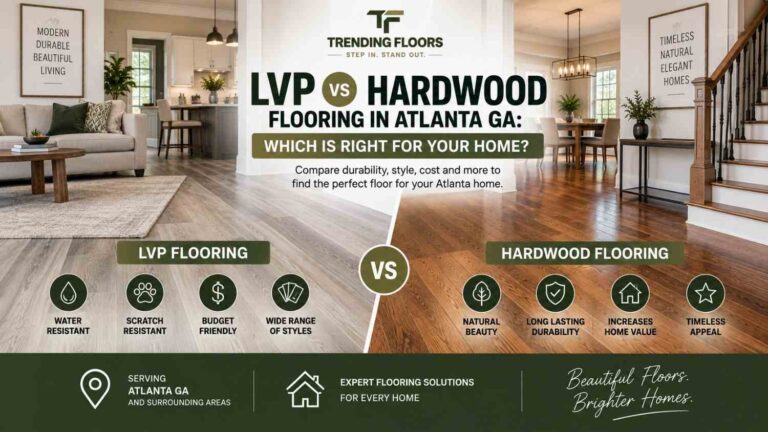
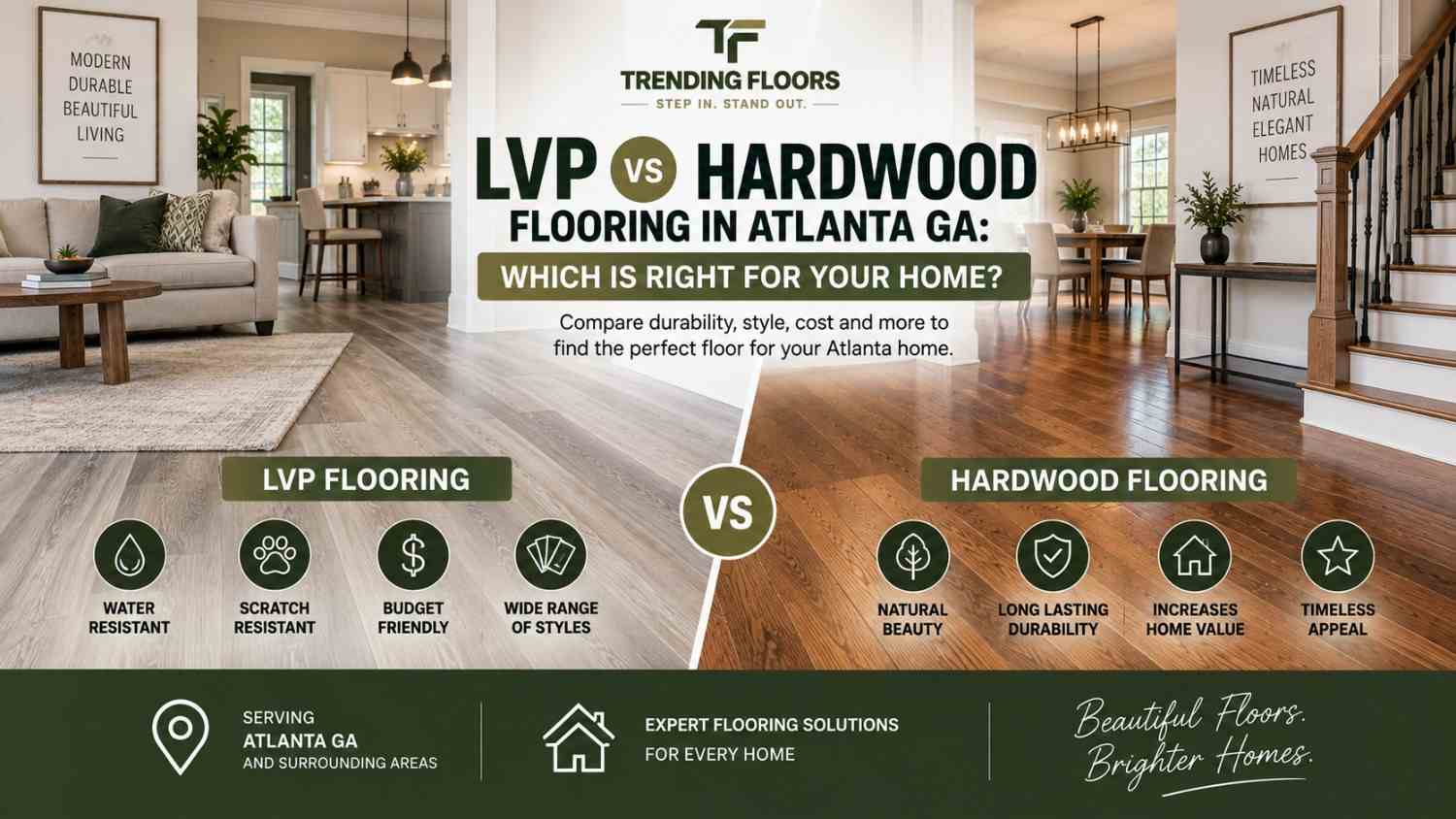
It is the most common flooring decision Atlanta homeowners face in 2026 – and one where getting it wrong costs real money. LVP or hardwood? Both look great in showroom samples. Both are installed daily in Metro Atlanta homes. But they perform very differently under Georgia’s specific conditions – concrete slab foundations, humid subtropical climate, and a resale market where buyer expectations vary significantly by neighborhood and price point.
This guide gives Atlanta homeowners an honest, locally-specific comparison of LVP and hardwood – covering performance, cost, durability, resale value, and the specific conditions in which each material genuinely wins. No manufacturer bias. No generic national advice. Just the comparison that makes sense for Metro Atlanta homes.
The Fundamental Difference – What Each Material Actually Is
Understanding what LVP and hardwood are at a material level is the starting point for any honest comparison.
What LVP Actually Is
Luxury vinyl plank is a multi-layer synthetic product – a rigid core (SPC or WPC) with a photographic wood-look layer beneath a protective wear layer. It is not wood. It contains no organic material. Its waterproof core is immune to the moisture conditions that affect every wood product. It cannot be refinished – when the wear layer is worn through, the plank must be replaced. It is available in formats that credibly replicate real wood at normal viewing distance, and the best products are genuinely difficult to distinguish from hardwood in finished photographs.
What Hardwood Is
Solid hardwood is milled from a single piece of wood – a natural organic material that breathes with its environment, absorbs and releases moisture with seasonal changes, and develops a patina over decades of use that no synthetic product replicates. It can be sanded and refinished multiple times over its lifetime – a 100-year-old solid hardwood floor can be refinished back to like-new condition. It is the only flooring material that genuinely increases in character over time rather than degrading. It is also the most demanding flooring material in terms of subfloor requirements and ongoing environmental management.
Georgia Climate and Subfloor – The Most Important Local Context
In most of the United States, the LVP vs hardwood decision is primarily aesthetic and financial. In Metro Atlanta, the decision has a third dimension that overrides both for many homeowners – Georgia’s concrete slab foundations and humid subtropical climate create conditions where solid hardwood is genuinely problematic in ways that most national flooring guides don’t account for.
The Concrete Slab Problem
Virtually all Metro Atlanta homes built after 1970 – covering the vast majority of Gwinnett County and most of North Fulton County’s housing stock – sit on concrete slab foundations. Solid hardwood should not be installed directly over concrete. Concrete continuously emits moisture vapor that solid wood absorbs, causing it to cup, gap, and eventually buckle over time regardless of installation quality. According to the National Wood Flooring Association, solid hardwood over concrete is not a recommended installation method under any conditions.
LVP flooring is completely immune to this problem. Its waterproof core neither absorbs nor emits moisture – it performs identically over concrete slab in Georgia’s humid August as it does over a wood subfloor in January’s drier air. For Atlanta’s slab homes, this single factor makes LVP the safer, lower-risk choice regardless of any other consideration.
Georgia’s Humidity and Hardwood
Metro Atlanta’s average annual relative humidity of approximately 69% – with summer peaks regularly exceeding 75% – creates significant seasonal moisture cycling in real wood floors. Solid hardwood expands during humid summers and contracts during drier winters. Over years, this movement creates minor gaps between boards, causes edge cupping in humid periods, and produces the floor noise that Atlanta homeowners in older homes frequently experience. Engineered hardwood handles this movement significantly better than solid wood – its cross-ply construction is far more dimensionally stable. LVP handles it completely – the waterproof core simply doesn’t respond to humidity changes.
LVP vs Hardwood – Category by Category Comparison for Atlanta Homes
Waterproofing and Moisture Resistance
LVP wins – no contest. 100% waterproof through the core. Pet accidents, spilled drinks, Georgia summer humidity, concrete slab moisture vapor – none of it affects LVP. For Atlanta households with children, multiple pets, or homes in Chattahoochee-adjacent neighborhoods where ambient moisture is elevated, LVP’s waterproofing is not just a convenience – it’s a meaningful protection against floor failure.
Solid hardwood is not waterproof and is not water-resistant in any meaningful sense. Engineered hardwood is water-resistant – it handles normal household moisture exposure better than solid wood – but is not waterproof and can be damaged by sustained moisture exposure over time.
Durability and Scratch Resistance
LVP wins for surface scratch resistance. Hardwood wins for long-term structural durability.
A quality LVP product with a 20-mil wear layer is more scratch-resistant at the surface than most hardwood species at equivalent price points. Dog claws, furniture dragging, and heavy daily foot traffic leave LVP’s wear layer unmarked for years. Hardwood – particularly softer species like pine and cherry – scratches more easily and shows wear in high-traffic areas more quickly than quality LVP.
The difference: when LVP’s wear layer is eventually worn through, the plank must be replaced. When hardwood’s surface is worn or scratched, it can be sanded and refinished – restoring like-new condition for another decade. A solid hardwood floor installed in good condition can last 100+ years with periodic refinishing. The best LVP will last 15–25 years before replacement is required.
Authenticity and Appearance
Hardwood wins – no synthetic product fully replicates real wood.
The best LVP products available in 2026 are remarkably convincing – wide-plank formats with realistic grain texture and matte finishes are genuinely difficult to distinguish from hardwood in photographs and at normal viewing distance. But in person, under careful examination, or in direct sunlight, the difference is perceptible to buyers and appraisers who know what they are looking at. Hardwood develops a character over time – deepening color, subtle variation in boards, the warmth of genuine organic material – that no engineered product replicates.
For Atlanta homeowners who care about authenticity and are willing to manage the material requirements that come with it, hardwood delivers something LVP simply cannot.
Resale Value in Atlanta’s Market
It depends on the neighborhood and price point.
In Metro Atlanta’s luxury market – Alpharetta’s Windward and Country Club of the South, Johns Creek’s St. Ives, Sandy Springs’ Perimeter Center corridor, and Buckhead – buyers at the $600K+ price point expect real hardwood. Quality LVP is accepted in these markets but does not command the same premium. Hardwood flooring in these communities produces a stronger appraisal outcome and a more competitive listing presentation.
In Gwinnett County’s active family market – Lawrenceville, Duluth, Norcross, Lilburn, and surrounding communities – quality LVP in warm oak tones produces listing results that are essentially equivalent to hardwood at the typical $300K–$500K price point. Buyers in this market prioritize durability and low maintenance as highly as authenticity, and LVP’s waterproof properties are a genuine selling point.
The honest resale guidance: if you are in a market where $600K+ buyers are your pool, invest in engineered hardwood. If you are in Gwinnett County’s family market, quality LVP is a fully defensible investment that will not hurt your listing.
Installation and Subfloor Requirements
LVP wins – significantly easier to install over Atlanta’s slab homes.
LVP’s floating installation over properly prepared concrete requires subfloor flatness within tolerance and moisture testing – but no vapor barrier requirements, no adhesive in most installations, and no acclimation period beyond 24 hours at room temperature. A main-floor LVP installation is typically completed in one to two days.
Solid hardwood over wood subfloors requires nail-down or staple-down installation, 5–7 days of acclimation in Atlanta’s summer humidity, and precise moisture content matching between the subfloor and the flooring. Site-finished solid hardwood adds multiple additional days for sanding, staining, and finish coats. The total elapsed timeline from material delivery to usable floor is typically 7–10 days for solid hardwood versus 2–3 days for engineered hardwood and 1–2 days for LVP.
Maintenance Requirements
LVP wins – dramatically lower maintenance.
LVP requires sweeping, occasional damp mopping, and prompt cleanup of spills. No sealing. No refinishing. No seasonal maintenance. No humidity management. It performs consistently with minimal attention for its entire lifespan.
Hardwood requires more careful daily maintenance – avoiding excessive moisture during cleaning, managing indoor humidity to prevent seasonal movement, periodic professional cleaning, and refinishing every 8–15 years depending on traffic. In Metro Atlanta’s humid climate, humidity management is particularly important – fluctuations outside the 30–50% range recommended by the NWFA will cause measurable movement in solid hardwood floors over time.
Cost
LVP wins on installed cost. Hardwood wins on lifetime cost when refinishing is factored in.
Quality LVP (20-mil SPC core) installs for $5–$8 per square foot in Atlanta. Engineered hardwood installs for $8–$15 per square foot. Solid hardwood (site-finished) installs for $10–$18 per square foot. The initial cost difference is significant – a 1,500 square foot main floor costs $7,500–$12,000 for quality LVP versus $12,000–$22,500 for solid hardwood.
Over 30 years, however, LVP will need replacement (at current costs) while solid hardwood will need 2–3 refinishing cycles at $3.50–$6 per square foot each – a significantly lower recurring cost than full replacement. For homeowners planning to stay in an Atlanta home for 20+ years, the lifetime cost comparison narrows considerably.
Which Is Better for Each Room in an Atlanta Home
Main Living Areas and Open Plans – LVP or Engineered Hardwood
For Atlanta’s slab homes – the majority of the market – engineered hardwood is the correct wood choice and LVP is the correct waterproof choice. Solid hardwood should not be used over concrete regardless of room type. For households prioritizing durability and low maintenance in a busy main floor, LVP is the practical recommendation. For households prioritizing authentic wood character and resale performance in a price bracket where it matters, engineered hardwood is the recommendation – with proper moisture testing and subfloor preparation.
Kitchens – LVP
LVP wins in kitchens without meaningful competition. The moisture environment of a working kitchen – spills, pet water bowls, dishwasher steam – creates ongoing moisture exposure that hardwood handles less reliably than LVP’s waterproof core. The seamless transition from main-floor LVP through to the kitchen creates a cohesive open-plan look that is the dominant design specification in Metro Atlanta’s 2026 renovation market.
Bathrooms – LVP or Tile
LVP is appropriate in bathrooms with proper installation – expansion gaps sealed, transitions watertight. Hardwood is not appropriate in bathrooms under any configuration. For master bathrooms, large-format porcelain tile remains the premium specification in Atlanta’s mid-to-upper market.
Bedrooms – Either, Based on Priorities
Bedrooms are where the choice is most genuinely personal. LVP is practical and durable. Engineered hardwood delivers authentic wood warmth. The humidity conditions in bedrooms are typically more stable than main floors. Either material performs well in this application – the decision comes down to budget, aesthetic preference, and whether you want the entire home to match.
Basements – LVP Only
Basements are LVP’s strongest application and hardwood’s worst. Below-grade concrete has the highest moisture vapor transmission of any surface in Atlanta homes. No wood product – solid or engineered – should be considered for Metro Atlanta basement floors without an exceptional moisture mitigation system in place. LVP is the correct choice for Atlanta basements without reservation.
The Honest Recommendation for Most Atlanta Homeowners
For the majority of Metro Atlanta homeowners – particularly those in Gwinnett County’s slab homes, active family households, and homes in the $300K–$600K market range – quality LVP is the correct main-floor choice. It handles Georgia’s conditions reliably, costs less to install, requires virtually no ongoing maintenance, and produces listing results that fully satisfy buyers at the dominant Atlanta price points.
For homeowners in North Atlanta’s luxury market ($600K+), planning to stay in a home for 20+ years, or for whom authentic wood character is a genuine priority – engineered hardwood is the correct recommendation over concrete slabs, and solid hardwood for homes with wood subfloors. The additional cost and maintenance requirements are justified by the material’s authenticity, longevity, and resale performance in this market segment.
For a broader look at which flooring material is right for your specific Atlanta home, neighborhood, and household, see our complete guide to the best flooring for Atlanta GA homes.
Frequently Asked Questions – LVP vs Hardwood Flooring Atlanta GA
For additional questions about flooring materials and installation across Metro Atlanta, visit our Atlanta flooring FAQ.
Is LVP or hardwood better for Atlanta homes?
It depends on your home’s subfloor, your household’s lifestyle, and your market position. For Atlanta’s predominant slab-foundation homes, LVP is safer and more practical – solid hardwood should not be installed over concrete. For households prioritizing low maintenance and waterproofing, LVP wins. For homeowners in Atlanta’s $600K+ market who want authentic wood character and maximum resale performance, engineered hardwood is the better recommendation over properly prepared slabs. Neither is universally better – the right answer depends on your specific situation.
Does hardwood add more value than LVP in Atlanta?
In Metro Atlanta’s luxury market ($600K+) in Alpharetta, Johns Creek, Sandy Springs, and Buckhead – yes, hardwood adds more resale value than LVP. Buyers at this price point expect real wood. In Gwinnett County’s family market ($300K–$500K) – quality LVP produces listing results essentially equivalent to hardwood and does not negatively affect resale. The resale advantage of hardwood is real in the luxury segment and minimal in the mid-market segment.
Can you install hardwood floors over concrete slabs in Atlanta?
Solid hardwood should not be installed over concrete – the National Wood Flooring Association does not recommend this installation method under any conditions. Concrete continuously emits moisture vapor that solid wood absorbs, causing cupping, gapping, and eventual buckling. Engineered hardwood can be safely installed over properly prepared and moisture-tested concrete slabs. LVP is completely compatible with concrete slabs and is the most practical wood-look choice for Atlanta’s predominant slab-foundation homes.
How long does LVP last compared to hardwood in Atlanta?
Quality LVP with a 20-mil wear layer professionally installed lasts 15–25 years in normal Atlanta residential use before replacement is needed. Solid hardwood installed correctly can last 50–100+ years with periodic refinishing – the refinishing cost every 8–15 years is significantly less than full LVP replacement. For homeowners planning to stay in a home for 30+ years, the lifetime durability of hardwood is a genuine financial advantage despite the higher initial cost.
Which is easier to maintain – LVP or hardwood in Atlanta?
LVP is significantly easier to maintain. It requires only sweeping and occasional damp mopping – no sealing, no refinishing, no humidity management, no special cleaning products. Hardwood requires more careful cleaning (avoiding excessive moisture), indoor humidity management within the 30–50% range recommended by the NWFA, and professional refinishing every 8–15 years. In Metro Atlanta’s humid climate, the humidity management requirement for hardwood is a real ongoing responsibility that LVP completely eliminates.
What is the cost difference between LVP and hardwood in Atlanta?
Quality LVP (20-mil SPC core) installs for $5–$8 per square foot in Atlanta. Engineered hardwood installs for $8–$15 per square foot. Solid hardwood (site-finished) installs for $10–$18 per square foot. A 1,500 square foot main floor costs $7,500–$12,000 for quality LVP versus $15,000–$27,000 for solid hardwood installed and finished. The initial cost difference is significant – though hardwood’s refinishing longevity narrows the lifetime cost comparison for homeowners staying in a property for 20+ years.
Does Trending Floors install both LVP and hardwood in Atlanta?
Yes. Trending Floors installs LVP, engineered hardwood, solid hardwood, tile, carpet, and epoxy flooring across Metro Atlanta – Lawrenceville, Alpharetta, Johns Creek, Sandy Springs, Roswell, and the broader Gwinnett County and North Fulton County area. We provide honest, locally-specific guidance on which material is right for your specific home, subfloor, household, and market position – not the material with the highest margin. Call (404) 944-2548 or book online to schedule your free in-home consultation.
Not Sure Which Is Right for Your Atlanta Home?
Trending Floors is a licensed, insured flooring contractor based in Lawrenceville, serving Metro Atlanta homeowners since 2018. We install both LVP and hardwood – and we’ll give you an honest recommendation based on your specific home, subfloor conditions, household needs, and market position – not a sales pitch for whichever material has the higher margin.
Book your free flooring consultation in Atlanta today – bring your questions, and we’ll bring the samples and the honest answers.
About Trending Floors
Trending Floors is a licensed and insured flooring contractor based at 465 Maltbie Street, Suite 240, Lawrenceville, GA 30046, serving Metro Atlanta homeowners since 2018. We install LVP, engineered hardwood, hardwood, tile, carpet, and epoxy flooring – all with our own trained crews, written estimates, and workmanship warranties on every project.
(404) 944-2548 | estimates@trendingfloors.com | Mon–Sat 8am–6pm