
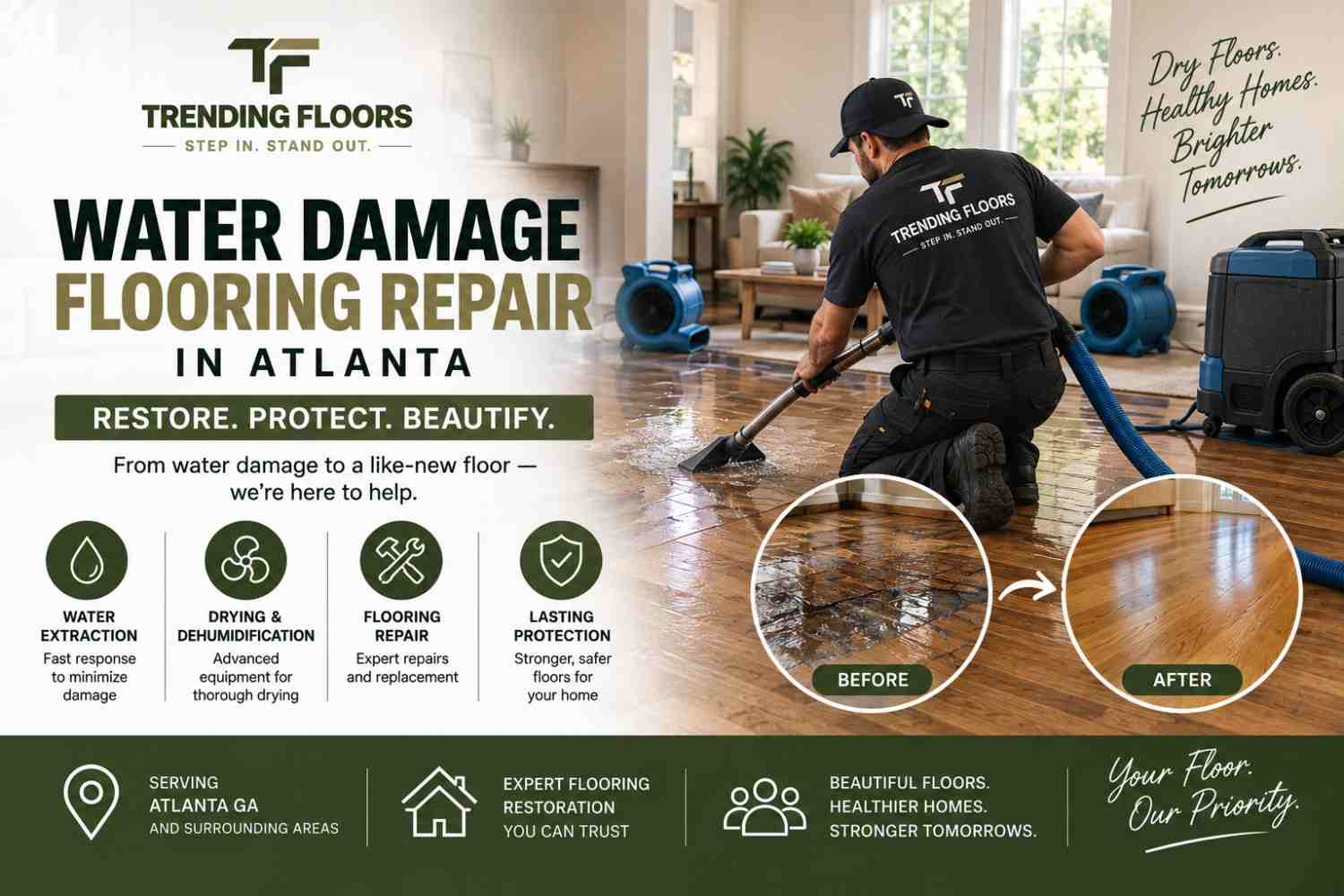
GA: What to Do & What It Costs
Water damage to flooring is one of the most stressful home emergencies Atlanta homeowners face – and one where the decisions made in the first 48 hours determine whether the outcome is a straightforward repair or a full replacement project. In Metro Atlanta’s humid subtropical climate, where summer temperatures accelerate mold growth faster than most national guides account for, the window for effective action is genuinely shorter than most homeowners expect.
This guide gives Atlanta homeowners the complete picture – what to do immediately after water damage, how Georgia’s climate affects your timeline, what happens to each flooring type when it gets wet, what repair and replacement realistically costs in 2026, and how to navigate the insurance claim process that most Metro Atlanta water damage events involve.
The First 48 Hours – What You Do Now Determines the Outcome
Water damage flooring repair in Atlanta is a time-sensitive emergency. Mold begins developing on wet organic materials – wood subfloors, carpet padding, and hardwood – within 24 to 48 hours in normal conditions. In Metro Atlanta’s summer climate, where indoor temperatures in water-damaged rooms can climb rapidly and outdoor humidity regularly exceeds 75%, mold growth can begin in as little as 12 hours. The actions you take in the first two days determine whether you are managing a flooring repair or a mold remediation project.
Step 1 – Stop the Water Source Immediately
Before anything else – identify and stop the source of water entry. Burst pipes require shutting off the main water supply. Appliance leaks – dishwasher, washing machine, refrigerator ice maker, water heater – require disconnecting the appliance and shutting off the supply line. Roof or exterior water entry requires tarping or temporary weatherproofing. No flooring contractor can help you while the water source is still active. Stop the source first, every time.
Step 2 – Remove Standing Water Immediately
Standing water must be extracted as quickly as possible. For small events – a localized appliance spill or minor leak – wet-dry vacuum extraction followed by thorough toweling is appropriate. For larger events covering significant square footage, professional water extraction equipment removes water at rates that household equipment simply cannot match. Every additional hour of standing water contact increases the depth of penetration into flooring, subfloor, and wall systems – and the cost of what follows.
Step 3 – Call a Water Damage Restoration Company First
This is the most important sequencing decision most Atlanta homeowners get wrong. A water damage restoration company and a flooring contractor are different services addressing different parts of the problem. An IICRC-certified restoration company – certified by the Institute of Inspection Cleaning and Restoration Certification – handles water extraction, structural drying, moisture documentation, and mold prevention. A flooring contractor handles assessment and replacement of finished flooring after the structure has been properly dried.
Installing new flooring over a structure that has not been professionally dried – even when the surface appears dry – is one of the most common and most expensive mistakes in the Atlanta water damage repair market. Residual moisture in subfloor panels, wall cavities, and concrete slabs creates mold conditions that destroy new flooring and the structure beneath it within months. Restoration first. Flooring replacement second. Always.
Step 4 – Document Everything for Your Insurance Claim
Before removing any damaged materials, photograph and video the full extent of visible damage from multiple angles. This documentation is essential for your insurance claim and should be comprehensive – every affected room, every damaged material, and the source of water entry clearly identified. Most Metro Atlanta homeowner’s insurance policies cover sudden and accidental water damage from internal sources – pipe bursts, appliance failures – but exclude gradual leaks and external flooding. Document the source and timeline of discovery clearly before any materials are removed.
How Georgia’s Climate Makes Atlanta Water Damage Different
Several Georgia-specific factors make water damage situations in Metro Atlanta more urgent and more complex than national guides suggest – and Atlanta homeowners need to understand these differences to make correct decisions.
Mold Develops Faster in Georgia’s Heat and Humidity
Atlanta’s average summer temperature combined with relative humidity regularly exceeding 70% creates ideal mold development conditions – warmer and more humid than most of the United States. The standard industry guideline of 24–48 hours for mold development assumes moderate conditions. In an Atlanta home in July or August without air conditioning operating in a water-damaged room, mold development on wet organic materials can begin within 12 hours. This compresses the effective response window significantly compared to the same event in a cooler, drier climate.
Concrete Slab Homes Retain Moisture Differently
In Metro Atlanta’s predominant slab construction – covering virtually all of Gwinnett County and most of North Fulton County’s post-1970 housing stock – water damage from above saturates the concrete slab as well as the flooring above it. Concrete is porous and retains moisture significantly longer than wood subfloors after a water event. Professional moisture testing of the concrete slab is required before any new flooring installation – not just a visual confirmation that the surface appears dry. A slab that looks dry 72 hours after a water event may still carry moisture vapor emission rates that will damage new flooring for weeks.
Atlanta’s Aging Plumbing Creates Specific Risk Patterns
Metro Atlanta’s older housing stock – particularly homes built between 1960 and 1990 in Gwinnett County communities like Lilburn, Stone Mountain, and older Lawrenceville neighborhoods – contains original plumbing increasingly prone to the slow leaks that cause the most insidious flooring damage. Unlike acute pipe failures that are immediately visible, slow leaks from toilet wax rings, dishwasher connections, and refrigerator ice maker lines deliver small amounts of water continuously over weeks – enough to saturate subfloor panels and cause rot without producing visible flooding that homeowners notice quickly.
Water Damage by Flooring Type – What Happens and What It Means
Hardwood Flooring – Most Vulnerable
Solid hardwood is the flooring material most severely affected by water exposure. Wood absorbs moisture rapidly – both from above during a water event and from saturated subfloor below. The immediate visible symptoms are cupping (board edges rise higher than the center) and crowning (the center of the board rises higher than the edges during the drying phase). Minor cupping from a recent, contained water event may partially resolve as wood dries – particularly if professional drying equipment is deployed promptly. Boards with significant cupping, dark staining indicating mold penetration, or soft spots indicating structural compromise should be assessed for replacement.
After proper structural drying is confirmed, hardwood floors with surface-level damage – minor cupping that resolved, finish damage without structural compromise – may be candidates for hardwood floor refinishing rather than full replacement. A professional assessment of remaining board thickness and structural integrity is required before this determination can be made. Refinishing at $3–$6 per square foot versus replacement at $9–$16 per square foot is a significant cost difference worth confirming before committing to removal.
LVP Flooring – Most Resilient Surface Material
LVP’s 100% waterproof core is its defining advantage in water damage scenarios. A properly installed LVP floor with sealed seams and transitions does not absorb water – it sits on the surface or travels to the edges rather than penetrating the plank. For contained water events caught quickly, LVP in good condition can often be dried and retained rather than replaced.
The critical caveat: LVP’s waterproofing protects the plank itself but not the subfloor beneath it. Water that travels under LVP through seams, transitions, or perimeter gaps reaches the subfloor and creates the same moisture and mold conditions it would under any other flooring. In Atlanta slab homes, water beneath LVP can sit against concrete for extended periods before being detected – precisely because the LVP surface appears undamaged. If water entry beneath LVP is suspected, sections must be lifted to assess and dry the subfloor before reinstallation or replacement. After a confirmed water event, waterproof LVP flooring is frequently the replacement material of choice in Atlanta homes – not only for its moisture resistance but because its floating installation allows quick deployment over properly dried slabs.
Carpet – Replace, Do Not Dry
Carpet and carpet padding saturated with water in an Atlanta home should be replaced in the vast majority of cases – not dried and reinstalled. The combination of carpet fiber, organic padding material, and Georgia’s warm humid climate creates near-ideal mold growth conditions even after professional drying. Mold spores and bacteria introduced during the water event remain in fiber and padding even after surface drying, and mold growth will recur when conditions allow. Carpet padding should always be replaced after significant water exposure. Carpet itself should be replaced in most cases – the exception being very brief surface contact from clean water sources, professionally extracted and dried immediately. Insurance adjusters in Atlanta’s market recognize carpet replacement as standard practice after water events.
Tile Flooring – Most Resistant Surface
Porcelain and ceramic tile are unaffected by water exposure at the surface level – they are inherently waterproof. Water damage to tile flooring presents through a different mechanism: water penetrating grout joints and reaching the adhesive layer beneath, causing adhesive failure and tile loosening. Tiles that remain firmly bonded after a water event – no hollow sound when tapped, no lippage change – typically do not require replacement. Grout joints that have been saturated may require re-grouting after the substrate is dried. Any tile that has loosened must be removed to allow proper assessment and drying of the substrate below.
Engineered Hardwood – Water-Resistant but Not Immune
Engineered hardwood handles brief moisture exposure better than solid hardwood – its cross-ply core is more dimensionally stable. However, prolonged exposure causes delamination of the core layers, swelling at plank edges, and structural compromise that cannot be repaired through refinishing. Engineered hardwood exposed to brief surface moisture with no edge swelling or delamination after professional drying may be salvageable. Extended exposure or visible delamination indicates replacement is required.
Subfloor Damage – The Hidden Consequence of Water Events
The subfloor beneath water-damaged flooring is frequently more severely affected than the finished flooring above it – and addressing subfloor damage before installing new flooring is non-negotiable. Our comprehensive subfloor repair guide for Atlanta homeowners covers the full assessment and repair process – but here are the key water-damage-specific considerations.
In Atlanta’s slab homes, water events saturate the concrete slab and any underlayment or adhesive layer between it and the finished flooring. Professional moisture testing – calcium chloride or RH in-situ probe – must confirm that the slab is within acceptable moisture vapor emission limits before any new flooring installation. This testing takes 24–72 hours to complete accurately and cannot be rushed without compromising the reliability of the result.
In older Atlanta homes with wood subfloors over crawl spaces or basements, water events that saturate OSB or plywood subfloor panels cause structural degradation that requires panel replacement before new flooring installation. Soft spots, visible staining, and musty odor after a water event all indicate subfloor panel damage that must be addressed before new flooring goes down – not concealed beneath it.
Navigating Insurance Claims for Water Damaged Flooring in Atlanta
What Atlanta Homeowner’s Insurance Typically Covers
Standard Georgia homeowner’s insurance covers sudden and accidental water damage from internal sources – burst pipes, appliance failures, and roof damage from covered weather events. It typically does not cover gradual leaks that developed over time, flooding from external sources, or damage resulting from deferred maintenance. The distinction between sudden and gradual damage is the most common insurance dispute in Metro Atlanta water damage claims. Document the timeline of discovery clearly – when you noticed the damage and what the source appears to be – before any materials are removed.
The Adjuster Process and Flooring Timeline
After filing a claim, an insurance adjuster will inspect the damage and prepare a scope of loss – a line-item description of the work required and associated allowances. Do not begin flooring replacement until the adjuster has inspected and the scope is agreed – premature replacement eliminates the adjuster’s ability to assess full damage extent and may affect coverage.
Emergency stabilization – extraction, drying, temporary protection of exposed subfloors – is appropriate immediately and is covered under most policies’ emergency mitigation provisions.
Adjuster allowances may not reflect current Metro Atlanta market rates. Contractor estimates frequently identify differences between adjuster allowances and actual replacement costs, and the supplement process – requesting additional coverage based on documented actual costs – is standard practice in the Atlanta market. Working with a flooring contractor experienced in insurance claim documentation is a significant practical advantage.
Water Damage Flooring Repair and Replacement Costs in Atlanta GA
Atlanta water damage flooring costs vary significantly based on the extent of damage, the flooring material affected, subfloor conditions, and whether mold remediation is required before replacement. Realistic 2026 ranges for Metro Atlanta:
- Hardwood floor repair – minor cupping, professional drying plus refinishing: $5–$10 per sq ft
- Hardwood floor replacement – water-damaged boards: $9–$16 per sq ft installed
- LVP replacement after water event: $5–$9 per sq ft installed
- Carpet and padding replacement: $5–$10 per sq ft installed
- Engineered hardwood replacement: $8–$15 per sq ft installed
- Tile replacement – full removal and reinstallation: $10–$18 per sq ft
- Subfloor panel replacement – typical bathroom or kitchen area: $800–$2,500
- Mold remediation if required before flooring replacement: $500–$6,000+ depending on extent
- Professional water extraction and structural drying: $1,874–$15,960 depending on scope
- Concrete moisture testing – calcium chloride plus RH probe: $200–$500
Most Metro Atlanta homeowner’s insurance policies cover sudden and accidental water damage – meaning flooring replacement cost is often partially or fully covered after the deductible. Working with a flooring contractor who can document damage accurately and provide line-item estimates in the format adjusters require is a significant practical advantage in the claim process.
Choosing a Flooring Contractor for Water Damage Repair in Atlanta
Water damage flooring projects require contractor experience that not every Atlanta flooring installer has. When evaluating contractors for post-water-damage replacement, ask specifically about their experience with insurance claim documentation, their process for verifying structural drying is complete before installation, and whether they perform moisture testing of the subfloor before any new flooring goes down.
A contractor who is eager to install new flooring before proper drying is confirmed – to meet your timeline or move the project forward quickly – is not protecting your interest. The most expensive outcome in Atlanta water damage flooring is installing new flooring over a structure that wasn’t properly dried, discovering mold growth months later, and repeating the entire project.
Trending Floors provides professional flooring installation across Metro Atlanta for post-water-damage replacement projects. We work directly with insurance adjusters on scope and documentation, require confirmation of professional structural drying before any installation, perform moisture testing of all subfloors before new flooring goes down, and provide written estimates that support the insurance supplement process where adjuster allowances don’t reflect current market rates.
Frequently Asked Questions – Water Damage Flooring Repair Atlanta GA
For additional questions about flooring materials, installation, and costs across Metro Atlanta, visit our Atlanta flooring FAQ.
What should I do first if my floors are water damaged in Atlanta?
Stop the water source first – shut off the main water supply or disconnect the responsible appliance. Remove standing water immediately with a wet-dry vacuum or call a professional extraction service for larger events. Call an IICRC-certified water damage restoration company before calling a flooring contractor – proper structural drying must precede any flooring replacement. Document all damage with photos and video before any materials are removed, and notify your insurance company as soon as possible after the damage is discovered.
How quickly does mold develop after water damage in Atlanta?
In Metro Atlanta’s summer climate – with temperatures regularly exceeding 85°F and humidity above 70% – mold can begin developing on wet organic materials within 12 to 24 hours. The industry standard guideline of 24–48 hours assumes moderate conditions. Georgia’s heat and humidity compress this window significantly, making prompt response more critical here than in cooler, drier markets. Professional structural drying using commercial dehumidifiers and air movers is essential to prevent mold growth after any significant water event in an Atlanta home.
Can water damaged hardwood floors be saved in Atlanta?
Sometimes – it depends on the duration of exposure, extent of cupping or swelling, and whether mold has penetrated the wood. Hardwood that cupped recently from a brief, contained event and was professionally dried promptly may partially or fully recover. Boards with significant cupping, dark staining indicating mold penetration, or soft spots indicating structural compromise should be replaced. After professional drying is confirmed, minor surface damage to salvageable hardwood can often be addressed through refinishing rather than full replacement – saving $3–$10 per square foot compared to replacement cost.
Does homeowner’s insurance cover water damaged flooring in Atlanta?
Most standard Georgia homeowner’s insurance policies cover sudden and accidental water damage from internal sources – burst pipes, appliance failures, and roof damage from covered weather events. Gradual leaks that developed over time, flooding from external sources, and damage from deferred maintenance are typically excluded. Document the water source and timeline of discovery clearly to support coverage determination. The adjuster’s allowances may not reflect current Atlanta market rates – working with a flooring contractor experienced in insurance claims helps ensure the supplement process captures actual replacement costs.
How much does water damage flooring repair cost in Atlanta?
Atlanta water damage flooring costs vary widely by material and extent. Hardwood repair – professional drying plus refinishing – runs $5–$10 per square foot. Full hardwood replacement runs $9–$16 per square foot. LVP replacement runs $5–$9 per square foot. Carpet and padding replacement runs $5–$10 per square foot. Subfloor panel replacement for a typical bathroom or kitchen area runs $800–$2,500. If mold remediation is required, add $500–$6,000+ depending on extent. Most sudden water damage events are covered by homeowner’s insurance after the deductible.
Should I replace LVP after a water damage event in Atlanta?
Not necessarily the LVP itself – but the subfloor beneath it must be assessed. LVP’s waterproof core resists water penetration through the plank, but water that travels under LVP through seams or perimeter gaps reaches the subfloor and creates moisture and mold risk. If water got beneath the LVP, sections must be lifted to assess and dry the subfloor before reinstallation or replacement. LVP that remained properly sealed throughout the event, with confirmed dry subfloor conditions, can often be reinstalled rather than replaced.
How long after water damage can new flooring be installed in Atlanta?
New flooring should not be installed until professional moisture testing confirms structural drying is complete and moisture levels are within flooring manufacturer specifications. In Metro Atlanta’s climate, this typically takes a minimum of 3–7 days of professional drying for contained events – significantly longer for larger events or cases where concrete slabs or wall systems were saturated. Attempting to install new flooring before drying is confirmed is the most common cause of secondary damage – mold growth beneath new floors that requires a second full replacement within months of the initial repair.
Dealing With Water Damaged Floors in Your Atlanta Home?
Trending Floors provides post-water-damage flooring replacement across Metro Atlanta – Lawrenceville, Alpharetta, Johns Creek, Sandy Springs, Roswell, and the broader Gwinnett and Fulton County areas. We work with insurance adjusters, require confirmed structural drying before installation, perform subfloor moisture testing on every project, and provide written estimates that document actual replacement costs accurately for the insurance supplement process.
Book your free flooring assessment in Atlanta today – and get expert guidance from a local contractor who handles water damage flooring projects from assessment through installation.
About Trending Floors
Trending Floors is a licensed and insured flooring contractor based at 465 Maltbie Street, Suite 240, Lawrenceville, GA 30046, serving Metro Atlanta homeowners since 2018. We install LVP, engineered hardwood, hardwood, tile, and carpet – all with professional subfloor assessment, moisture testing, written estimates, and workmanship warranties on every project.
(404) 944-2548 | estimates@trendingfloors.com | Mon–Sat 8am–6pm